Orchestra
A desktop app where you build a web automation — clicking buttons, filling forms, scraping data — by pointing and clicking, and it hands you real, ready-to-use Playwright code at the end instead of locking your work inside a subscription.
🔗 Visit Orchestra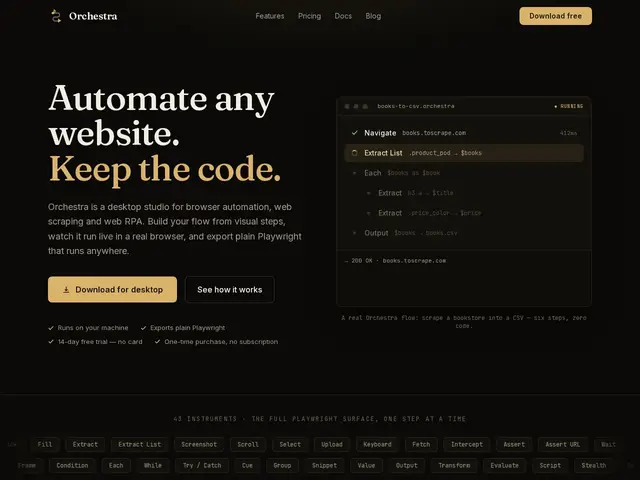
Description
Automating a repetitive task on a website — checking prices, filling out the same form daily, pulling data off a page — usually means either learning to code a scraper yourself, or paying monthly for a cloud RPA (robotic process automation) platform that owns your workflow. Orchestra takes a third path: it's a desktop app where you build the automation visually, watch it run in an embedded browser as you build it, and then export the whole thing as standalone Playwright code you own outright.
Under the hood, it offers 43 visual "instruments" covering navigation, data extraction, clicking, and logic/conditional control, plus a point-and-click selector picker and live variable tracking so you can see exactly what data is flowing through your automation as it runs. It handles the annoying real-world stuff — dynamic banners, popups, modals — with dedicated "cues," and it runs entirely on your own machine rather than in the cloud, with offline capability for up to 7 days. The business model is a $129 one-time lifetime license (14-day free trial) covering up to 3 devices, rather than a subscription — the pitch being that if the company ever shuts down, your exported Playwright flows keep working because the code is yours.
💬 Our review
The short version: for anyone who wants to automate browser tasks without becoming a Playwright expert first, or without committing to a monthly RPA subscription, the one-time $129 price and "you own the exported code" model is a genuinely good deal — the main risk is a smaller company behind it than the established RPA players.
Against subscription RPA platforms (the typical UiPath/Automation Anywhere category, or newer cloud scraping-as-a-service tools), Orchestra's local-first, one-time-purchase model is the standout differentiator: no recurring per-run charges, no cloud dependency, and crucially no lock-in — since the tool literally exports usable Playwright code, you're not stuck if you stop paying or the vendor disappears. Against writing Playwright by hand, Orchestra trades some precision and flexibility for a much faster on-ramp: the visual builder with live variable tracking gets non-programmers to a working automation quickly, though anyone who already knows Playwright well may find hand-written code easier to debug and maintain long-term than a GUI abstraction layer. At $129 for a lifetime license with a 14-day trial, the financial risk of testing it is low, and the value case is strong specifically for people who need occasional-but-recurring browser automation (price monitoring, QA testing, data pulls) without wanting a $50-300/month RPA subscription; power users running automation at real scale in production may still want the ecosystem and support depth of an established enterprise RPA vendor. <!-- ai-generated -->
💰 Pricing
📊 Global score
🤖 AI-enriched data
129$ paiement unique, essai gratuit 14 jours, licence valable sur 3 appareils, sans frais récurrents
Pros
Paiement unique de 129$, pas d'abonnement
Export en code Playwright réel — aucun verrouillage propriétaire
43 instruments visuels + suivi live des variables
Exécution locale, fonctionne hors-ligne jusqu'à 7 jours
Cons
Pas d'exécution cloud native — dépend de la machine locale
Moins d'écosystème/support qu'un acteur RPA établi (UiPath)
Licence limitée à 3 appareils
Peu d'information sur l'ancienneté ou la taille de l'équipe derrière le produit