Fitter
Turns any website or API into clean, structured JSON data by describing what you want in a config file — no scraping code to write or maintain.
🔗 Visit Fitter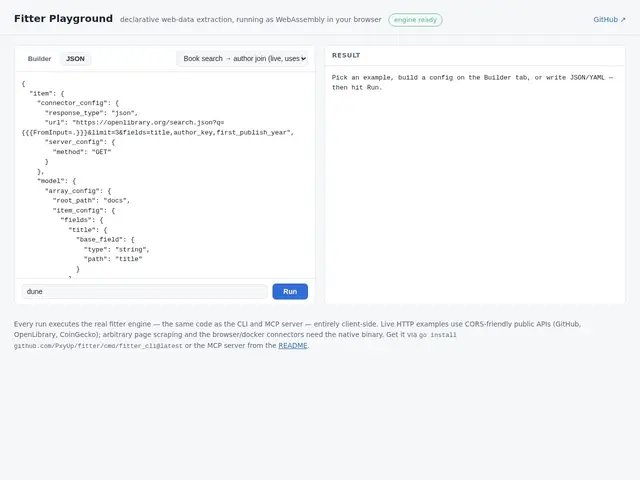
Description
Pulling structured data out of a website usually means writing and maintaining custom scraping code that breaks every time the site changes its layout. Fitter flips that: you write a JSON or YAML file describing what data you want and where it lives on the page, and Fitter handles the extraction — no scraping script, no headless-browser boilerplate.
Fitter runs in five different modes: as an MCP server (so AI assistants like Claude can call it directly), an AI-agent CLI, a standard command-line tool, a Go library, or a long-running service. It can pull from plain HTTP requests, headless browsers (Chromium via Playwright or Docker), static values, or local files, and extract from JSON, XML, HTML, XPath, or PDF sources. Everything runs locally with no third-party API dependency — the tool itself is a ~7MB Go binary compiled to WebAssembly that can run entirely client-side in a browser or as a server process. Configs support nested API calls with data enrichment, pagination, rate limiting, file downloads, and expression-based calculated fields, and because configs are just structured text, AI agents and LLMs can author them directly.
💬 Our review
The short version: if you need structured data out of a website or API and don't want to own a brittle scraping codebase, Fitter's config-driven approach — plus native MCP support so an AI assistant can write and run extraction configs for you — is a genuinely useful shortcut, and it's free and open source to boot.
Against general scraping frameworks like Scrapy or Puppeteer scripts you write yourself, Fitter's advantage is that configs are declarative and reusable rather than imperative code you have to maintain across site changes — though in practice any scraper (declarative or not) still breaks when a target site restructures its HTML, so this isn't a magic fix for scraping fragility, just a cleaner way to express and version the extraction logic. Against paid scraping-as-a-service platforms like Apify or ScrapingBee, Fitter runs entirely locally and costs nothing, at the tradeoff of you managing your own infrastructure and proxy/rate-limit handling instead of paying someone else to. With 126 GitHub stars and MIT licensing, it's a credible open-source project, and the MCP integration in particular is a forward-looking feature most scraping tools don't offer yet.
💰 Pricing
📊 Global score
🤖 AI-enriched data
Gratuit, licence MIT
Pros
Extraction déclarative par config JSON/YAML, pas de code à maintenir
Cinq modes d'usage dont serveur MCP pour agents IA
100% local, aucune dépendance API tierce
Support HTTP, navigateur headless, JSON/XML/HTML/XPath/PDF
Binaire léger (~7 Mo) compilé en WebAssembly
Cons
Reste sensible aux changements de structure des sites ciblés, comme tout scraper
Pas d'infrastructure managée (proxys, rotation IP) fournie
Communauté encore modeste comparée à Scrapy