Hubo
Gets a second AI agent to argue with the one that just wrote your code, back and forth, until they agree it's actually good — instead of one agent grading its own homework.
🔗 Visit Hubo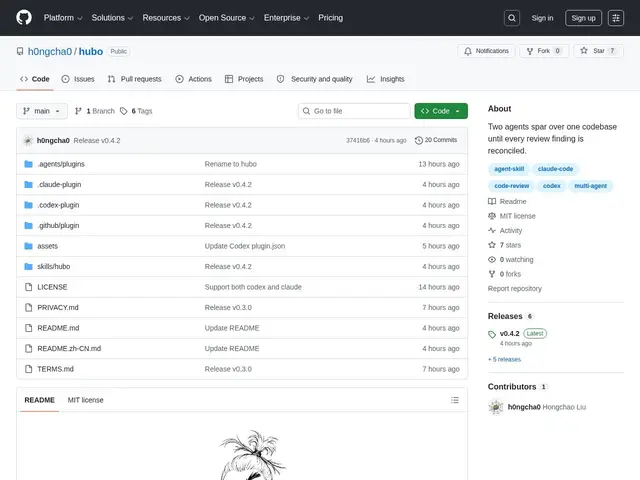
Description
When a single AI coding agent both writes code and reviews its own work, it tends to miss its own blind spots — the same reasoning that produced the bug is often the reasoning used to "check" it. Hubo fixes that by using two separate agents: one that does the implementation work, and a second, read-only review agent whose only job is to critically challenge it.
The two agents hold a persistent back-and-forth conversation, with the review agent raising findings and the work agent responding, continuing the loop until every finding is either resolved with evidence or escalated to a human for judgment. Because the review agent never writes code itself, it stays independent from the implementation and is meant to expose blind spots that self-review would miss, favoring evidence-based debate over unilateral approval. Hubo supports multiple coding-agent platforms including Claude Code, Codex, GitHub Copilot CLI, and OpenClaw, and requires a host environment capable of running multiple addressable agents simultaneously. It must be explicitly invoked — it doesn't run automatically on every prompt — and its name references a martial-arts technique from wuxia fiction, nodding to the idea of two hands working against each other for balance.
💬 Our review
The short version: if you've noticed your AI coding assistant approving its own work a little too easily, Hubo's structural fix — a separate, independent agent whose only job is to push back — targets a real and specific failure mode rather than just adding a generic "review my code" prompt.
Compared to simply asking the same agent to review its own output afterward (the default in most workflows), Hubo's separation of concerns is the actual innovation: a genuinely independent second agent is more likely to surface issues the first agent's own reasoning was blind to, similar to why human code review works better than self-review. Compared to a human reviewer, it's obviously faster and always available, but it inherits the ceiling of whatever underlying models are doing the reviewing — it escalates to a human when judgment calls arise, which is an honest acknowledgment of its limits rather than overclaiming full autonomy. It's free, open source, and young (7 GitHub stars), so expect a tool still being refined rather than a polished, widely-adopted standard — but the core idea is sound and worth trying if your team is already running Claude Code, Codex, or Copilot CLI.
💰 Pricing
📊 Global score
🤖 AI-enriched data
Gratuit, open source
Pros
Séparation stricte implémentation / revue par deux agents distincts
Boucle de discussion persistante jusqu'à résolution des points
Escalade vers un humain pour les décisions ambiguës
Compatible Claude Code, Codex, Copilot CLI, OpenClaw
Gratuit et open source
Cons
Doit être invoqué explicitement, pas automatique
Nécessite un hôte capable de faire tourner plusieurs agents en parallèle
Projet jeune (7 étoiles GitHub), qualité dépendante des modèles sous-jacents