ActionRail
Double-checks what an AI agent is about to do against your real, live data before letting it happen — so it can't confidently take an action based on outdated or wrong information.
🔗 Visit ActionRail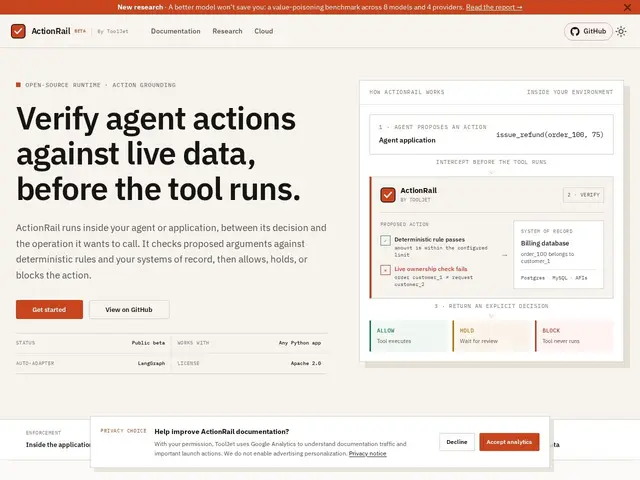
Description
AI agents can sound completely confident while acting on stale or hallucinated information — deleting a record that was already deleted, updating a price that already changed, or calling an API with parameters that no longer match reality. ActionRail is a runtime safety layer built by ToolJet that checks an agent's planned action against your actual live systems before it executes, and can allow, hold, or block the action based on rules you configure.
It connects to your real data through adapters for SQLite, PostgreSQL, MySQL, HTTP/REST APIs, and MCP servers, and uses a policy-plus-grounding decision pipeline rather than a simple allow-list. "Action Tests" let you define deterministic, executable contracts describing exactly what a given action is expected to do, and the framework can automatically discover and wrap tools via LangGraph integration. A framework-neutral Python SDK supports custom integrations beyond LangGraph, and an optional Django-based control plane with a React console gives teams rule management and activity monitoring, reporting only metadata back to the control plane while detailed values stay in the customer's own environment. It's currently in public beta with a v1 release planned for August 2026, and is free and open source.
💬 Our review
The short version: if you're worried about an AI agent executing an action based on data that's already out of date, ActionRail's live-verification-before-execution model is a real technical answer, and its own published red-team numbers are refreshingly specific rather than vague marketing claims.
The project's security testing showed 100% prevention of poisoned actions in its value-poisoning benchmark, while red-teaming 8 models across 4 providers without protection found attack success rates ranging from 1.7% to 63.3% — that range is a genuinely useful data point for judging how much this kind of grounding actually matters depending on which model you're running. Compared to Axtary, which focuses more on human-approval workflows and tamper-proof authorization tokens, ActionRail's differentiator is grounding actions against live system state (is this still true right now?) rather than primarily gating on policy and human sign-off — the two are complementary rather than directly substitutable. Being in public beta with v1 slated for August 2026 means some rough edges are expected, and the metadata-only reporting to the control plane is a reasonable privacy design, but as with any pre-1.0 safety tool, don't treat it as a substitute for your own testing before trusting it in a high-stakes production agent pipeline.
💰 Pricing
📊 Global score
🤖 AI-enriched data
Gratuit, open source, en beta publique (v1 prévue août 2026)
Pros
Vérifie les actions contre l'état réel des systèmes avant exécution
Chiffres de sécurité publiés et précis (100% de blocage en benchmark de poisoning)
Adaptateurs pour SQLite, PostgreSQL, MySQL, REST, MCP
Intégration LangGraph automatique + SDK Python neutre
Gratuit et open source
Cons
Encore en beta publique, v1 pas encore sortie
Nécessite de configurer des Action Tests pour tirer pleinement parti du système
Complémentaire plutôt que substitut d'une vraie revue humaine sur les actions critiques