Cygnus
A self-hosted alternative to services like AWS Lambda or Vercel Functions — run your own serverless platform on your own servers, with no container registry or YAML to manage.
🔗 Visit Cygnus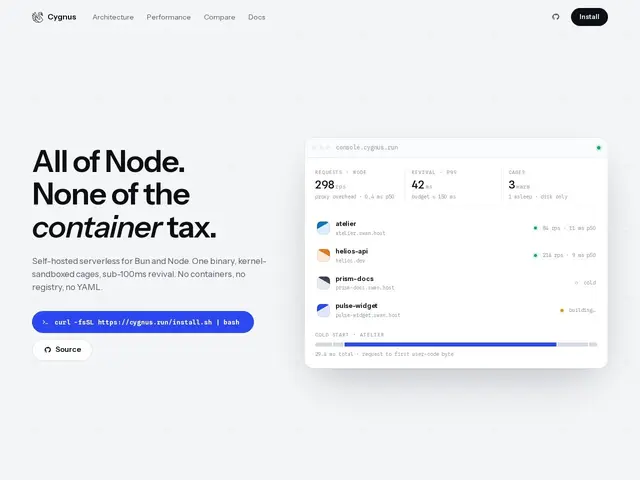
Description
Serverless platforms like AWS Lambda are convenient but hand your code and your bill to someone else's cloud. Cygnus is for people who want the same experience — deploy code, have it scale to zero when idle, and spin back up instantly on request — but running on their own infrastructure, without becoming a Kubernetes expert first.
Cygnus achieves this by using kernel-level sandboxing (Linux namespaces, seccomp, cgroups v2) instead of Docker-style containers, which is what lets it hit sub-100ms cold starts (with a stated goal of 30ms at the median) rather than the multi-second cold starts typical of container-based platforms. It runs Node.js and Bun applications, including native addons, and offers three deployment paths: a dashboard, Git push with automatic PR preview environments, or a CLI. Under the hood, a Rust daemon handles TLS termination and proxying via io_uring, real networking is implemented with veth and nftables rather than a userspace proxy, and idle apps go to disk-only state for true scale-to-zero. It's AGPL-3.0 licensed and open source, with a live demo available at console.cygnus.run.
💬 Our review
The short version: if you like the developer experience of Lambda or Vercel Functions — push code, forget about servers — but don't want to pay a cloud vendor or hand over your infrastructure, Cygnus is a legitimate self-hosted answer, and the kernel-sandboxing approach to hit sub-100ms cold starts is a real technical achievement, not just marketing copy.
Compared to self-hosting with Docker + Kubernetes, Cygnus removes an enormous amount of YAML and container-registry overhead — that's the core value proposition, and it's credible given the low-level networking (veth, nftables) and bytecode caching work described. Compared to actual managed serverless (AWS Lambda, Vercel, Cloudflare Workers), you trade zero-ops convenience for full control and zero recurring cloud bill, at the cost of having to run and secure the host yourself. The project is early — 4 GitHub stars at review time — so the usual early-adopter risk applies: fewer production war stories, a smaller community for troubleshooting, and features that may still be maturing. The AGPL license also matters if you're building a commercial SaaS around it, since AGPL requires you to open-source modifications if you offer the modified software as a network service.
💰 Pricing
📊 Global score
🤖 AI-enriched data
Gratuit, auto-hébergé, licence AGPL-3.0 (implique obligations de partage du code si modifié et exposé en service réseau)
Pros
Cold starts sous 100ms via sandboxing kernel plutôt que conteneurs
Zéro registre de conteneurs ni YAML à gérer
Scale-to-zero réel (état disque uniquement quand inactif)
Trois modes de déploiement (dashboard, Git push, CLI) avec preview PR
Démo live disponible pour tester avant d'installer
Cons
Projet jeune, communauté encore petite (4 étoiles GitHub)
Licence AGPL-3.0 contraignante pour un usage SaaS commercial modifié
Auto-hébergé = responsabilité de sécurité et de maintenance du serveur