Moonshine
An open-source toolkit for building voice AI that runs fully on-device — no internet connection, no per-request API bill.
🔗 Visit Moonshine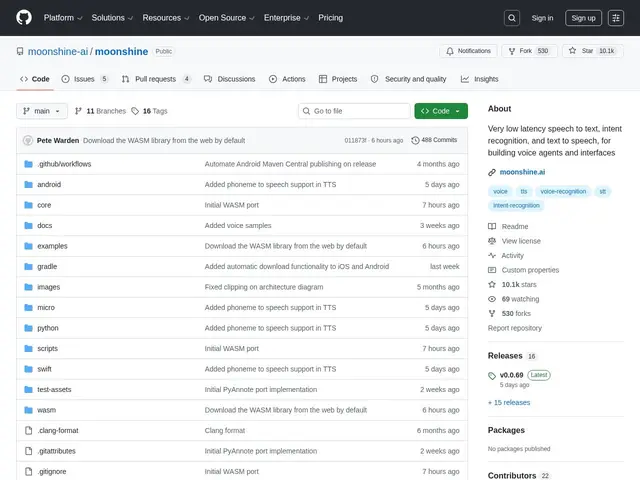
Description
Most voice assistants and transcription apps work by recording your voice and sending the audio over the internet to a company's servers, which then send back text — that's how Siri, Google Assistant and most "AI transcription" apps work under the hood. Moonshine takes a different approach: it's a toolkit that runs the entire speech-to-text and text-to-speech pipeline directly on your phone, laptop, or even a tiny Raspberry Pi, with no network connection required and no company logging your audio.
Moonshine is an open-source (MIT-licensed) voice AI toolkit built around a unified C++ core with bindings for Python, Swift, Java and Kotlin, letting the same models run natively on iOS, Android, macOS, Linux, Windows and Raspberry Pi. It covers speech-to-text in 8+ languages, text-to-speech in 20+ languages with voice cloning via ZipVoice, and includes intent recognition for building full voice-driven conversational agents. Independent benchmarks cited by the project claim higher transcription accuracy than OpenAI's Whisper Large V3 at a fraction of the model size, which matters directly for on-device inference speed and battery life. With 10,400+ GitHub stars and 511+ commits, it's actively maintained and positioned as production-ready rather than a research toy.
💬 Our review
The short version: if you need voice features (transcription, TTS, or a full voice assistant) that work offline, respect user privacy by design, and don't rack up per-minute API charges, Moonshine is one of the few toolkits mature enough to actually ship with.
Against cloud alternatives like OpenAI's Whisper API, Deepgram or Google Speech-to-Text, Moonshine's whole pitch is the absence of a server round-trip: no latency spike waiting for a network call, no audio ever leaving the device, and no bill that scales with usage. That tradeoff cuts both ways — you're running inference on the user's hardware, so you're bound by whatever CPU/NPU that device has, and you lose the easy "just call an API" simplicity of hosted services. For teams building privacy-sensitive apps (healthcare, legal, kids' apps) or products meant to work in low-connectivity environments, that tradeoff is usually worth it. For a quick prototype where you just want the best possible transcription quality with zero infra work, a hosted API is still less friction. Moonshine's claimed accuracy edge over Whisper Large V3 at smaller model sizes is a genuinely rare combination — most on-device models trade accuracy for size — and the 8+/20+ language coverage plus intent recognition means most teams won't need to bolt on a separate NLU layer.
💰 Pricing
📊 Global score
🤖 AI-enriched data
100% open source (MIT), modèles téléchargeables gratuitement via CLI ou auto-téléchargés par les SDK mobiles. Aucun coût par appel.
Pros
100% on-device, zéro dépendance réseau
Précision supérieure à Whisper Large V3 à taille réduite
Bindings natifs iOS/Android/desktop/Raspberry Pi
STT + TTS + reconnaissance d'intention dans un seul toolkit
Cons
Limité par la puissance de calcul de l'appareil cible
Moins "plug-and-play" qu'un simple appel API cloud
Écosystème/communauté plus petit que Whisper