Openship
A tool that lets you push your code and have it automatically built, deployed, and hosted with its own database and SSL — like a private version of Heroku or Vercel that you fully own and never pay a monthly bill for.
🔗 Visit Openship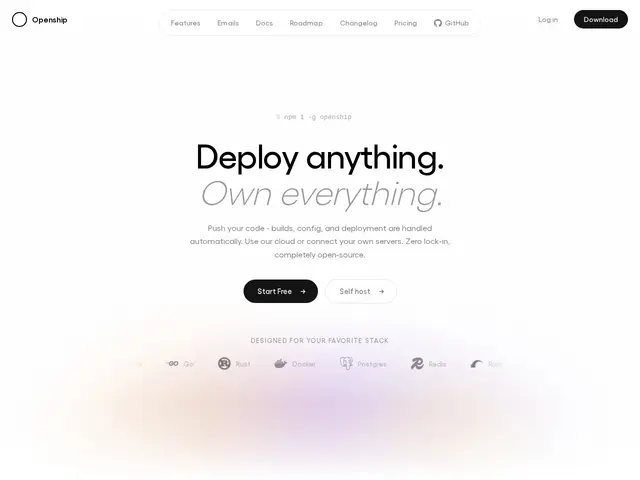
Description
Most app hosting today means renting space on someone else's cloud: you push code, a company like Heroku or Vercel builds and runs it for you, and you pay them every month for the privilege. Openship flips that arrangement — it's software you run yourself, on your own server, that does the same push-code-get-a-live-app magic (SSL certificates, databases, background jobs included) without a recurring bill to a hosting company.
Openship is an open-source deployment platform (MIT-licensed, 8,500+ GitHub stars) available in three modes: a desktop app for solo developers, a self-hosted server for teams, and a managed cloud version for teams that don't want to run infrastructure themselves. It handles builds and deployments for Node, Python, Go, Rust and other stacks, and bundles managed services most projects need anyway — PostgreSQL, Redis, MongoDB, MySQL, object storage, even a mail server — plus automatic SSL via Let's Encrypt and CDN integration. Self-hosting is free forever with no billing; Openship Cloud only charges for the compute and bandwidth actually used. It also exposes an MCP-compatible API, letting AI coding agents trigger deployments directly.
💬 Our review
The short version: if you're comfortable running your own server, Openship gets you most of what Vercel or Heroku offer — automatic builds, managed databases, SSL — without ever seeing a monthly hosting invoice; if you'd rather not manage a server at all, its own Cloud tier exists but doesn't obviously beat the incumbents on convenience yet.
Against Vercel, Heroku or Fly.io, Openship's pitch is ownership: self-hosting is genuinely free with no seat-based or usage-based tax, and you're not exposed to a platform's pricing changes or feature gating. The tradeoff is the one every self-hosted PaaS makes — you're now responsible for the server it runs on, security patches, and uptime, which is exactly the operational burden managed platforms exist to remove. The desktop-app mode for solo devs is a nice touch that competitors in this self-hosted PaaS space (Coolify, Dokploy) don't quite offer in the same form. At 8,500+ stars and 380+ commits it's actively developed, but teams with zero DevOps appetite should budget time for the inevitable rough edges of self-managing it, or use the Cloud tier while accepting it's unproven at incumbent scale.
💰 Pricing
📊 Global score
🤖 AI-enriched data
Auto-hébergement gratuit à vie, sans facturation. Openship Cloud : facturé au compute/bande passante réellement consommés ; services managés (PostgreSQL, Redis, MongoDB...) facturés séparément à l'usage.
Pros
Auto-hébergement 100% gratuit sans limite
Services managés inclus (base de données, cache, stockage, mail)
Trois modes d'usage : desktop, self-hosted, cloud
API compatible MCP pour agents IA
Cons
Maintenance serveur à la charge de l'utilisateur en self-hosted
Cloud tier jeune, sans historique face aux ténors
Nécessite des compétences DevOps de base pour l'auto-hébergement