Floci
Lets developers run fake-but-functional AWS, Azure and Google Cloud services on their own laptop for free, so they can test cloud code without a real cloud account, credit card, or bill.
🔗 Visit Floci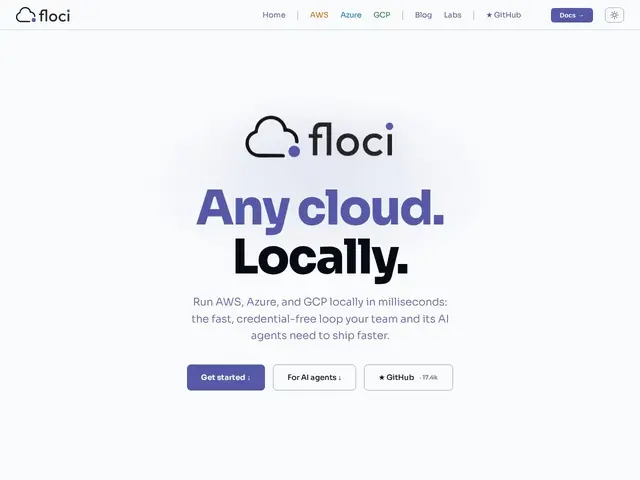
Description
Building software that uses cloud services like AWS Lambda or S3 usually means either paying for a real cloud account just to test your code, or juggling fake credentials and mock accounts to avoid a bill. Floci sidesteps both: it runs real, working versions of AWS, Azure and Google Cloud services directly on your own machine using Docker, with zero cloud account and zero credentials needed.
Floci is a free, open-source (MIT) local cloud emulator supporting 68 AWS services, 22 Azure services and 22 GCP services, with genuinely functional execution engines rather than simple mocks — Lambda functions run in real Docker containers, RDS uses real PostgreSQL/MySQL, ElastiCache uses real Redis. It starts in about 24 milliseconds and uses roughly 13 MiB of idle memory, ships as a ~90 MB Docker image, and requires no auth tokens at all. It's explicitly positioned as the modern free alternative to LocalStack, after LocalStack moved parts of its own local emulator behind mandatory authentication in March 2026 — a shift Floci's maintainers call out directly as the reason the project exists.
💬 Our review
The short version: if LocalStack's move to requiring an account and auth tokens for local testing annoyed you, Floci is a genuinely free, no-strings replacement that covers a very wide slice of AWS/Azure/GCP services with real execution behind them, not just mocked responses.
The direct comparison is LocalStack, and Floci's entire value proposition is reacting to LocalStack's March 2026 pivot toward gating features behind authentication — Floci stays MIT-licensed and credential-free by design, with the explicit promise (per its own docs) to avoid the same 'community edition sunset' pattern. Coverage-wise it's broad (68 AWS + 22 Azure + 22 GCP services) though, as with any emulator, edge-case service behavior can diverge from the real cloud provider, so it's a development/testing tool, not a substitute for staging against real infrastructure before a production launch. For CI pipelines, AI coding agents that need a safe sandbox, or anyone teaching cloud infrastructure without wanting students to rack up a bill, the zero-cost, zero-credential setup is hard to beat on convenience alone.
💰 Pricing
📊 Global score
🤖 AI-enriched data
100% gratuit et open-source (licence MIT), aucun palier payant ni fonctionnalité verrouillée.
Pros
100% gratuit, sans compte ni identifiants cloud requis
Exécution réelle (Docker, PostgreSQL, Redis) plutôt que simple simulation
Démarrage très rapide (~24ms) et empreinte mémoire minime
Couverture large : 68 services AWS, 22 Azure, 22 GCP
Cons
Comportements en périphérie du service peuvent différer du vrai cloud
Ne remplace pas un environnement de staging réel avant production
Projet plus jeune que LocalStack, historique plus court