Infinite Canvas
A free, endless digital whiteboard where you can drag out AI-generated images and videos, edit them, and connect the pieces together visually — instead of generating one image at a time in a chat window and losing track of your earlier attempts.
🔗 Visit Infinite Canvas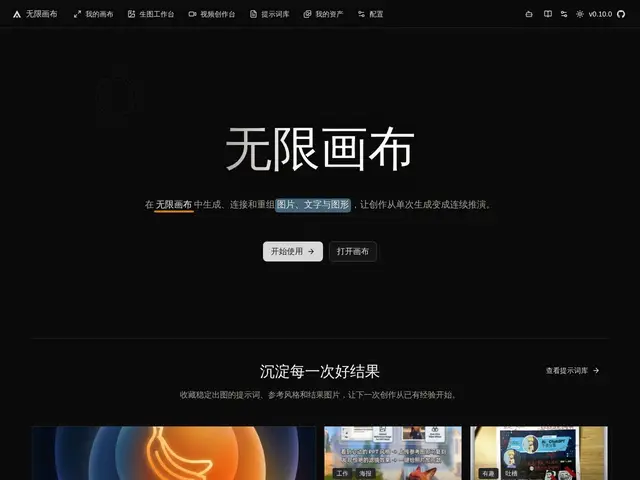
Description
Generating images or video with AI usually happens one prompt at a time in a chat-style interface, which makes it hard to compare variations, build on an earlier result, or see your whole creative process at once. Infinite Canvas replaces that with a visual, node-based workspace where every generation, edit and reference image is a piece you can arrange, connect and revisit.
Infinite Canvas is a free, open-source (AGPL-3.0, 3,800+ GitHub stars) canvas-based tool combining text-to-image generation, image-to-image editing, reference image handling, video generation and conversational AI assistants in one unlimited workspace. It supports node manipulation, connections, a minimap and undo/redo, integrates with Codex and Claude Code via MCP for a 'Canvas Agent,' and has a plugin system letting you install custom nodes via URL with a TypeScript SDK. It works with any OpenAI-compatible API, stores configurations locally in the browser via IndexedDB, and supports local or personal deployment (recommended during its current development phase) as well as multi-agent workflows.
💬 Our review
The short version: Infinite Canvas is a genuinely different way to work with AI image and video generation — visual and spatial instead of a linear chat log — and being free, open-source and self-hostable means there's no subscription standing between you and trying it.
Most AI generation tools (whether standalone image generators or chat-based assistants) are built around a single linear conversation, so the closest comparison is other canvas-style creative tools rather than a typical AI image generator — the value here is specifically in the spatial, node-based workflow for comparing and building on multiple generations at once, which a chat interface structurally can't offer. Being AGPL-3.0 licensed means any modified, redistributed version must also stay open source, which matters if you're planning to build a commercial product on top of it rather than just using it yourself. The project explicitly recommends local or personal deployment during its current development phase rather than production use at scale, which is honest but worth taking seriously — treat it as a powerful personal creative tool right now, not yet a hardened team platform.
💰 Pricing
📊 Global score
🤖 AI-enriched data
Entièrement gratuit et open-source (licence AGPL-3.0). Coûts éventuels liés à l'API de génération IA compatible OpenAI utilisée.
Pros
Gratuit, open-source, auto-hébergeable
Espace de travail visuel type canevas plutôt qu'un chat linéaire
Intégration MCP avec Codex et Claude Code (Canvas Agent)
Système de plugins extensible via SDK TypeScript
Cons
Déploiement local/personnel recommandé, pas encore pensé pour la production à grande échelle
Licence AGPL-3.0 contraignante pour un usage commercial dérivé
Nécessite une API de génération IA compatible OpenAI séparée