QitOps CLI Tools
A free, open-source command-line tool that replaces a whole stack of separate testing tools — for APIs, load, security, and web pages — with one program, so QA engineers don't have to juggle Postman, k6, and browser scripts separately.
🔗 Visit QitOps CLI Tools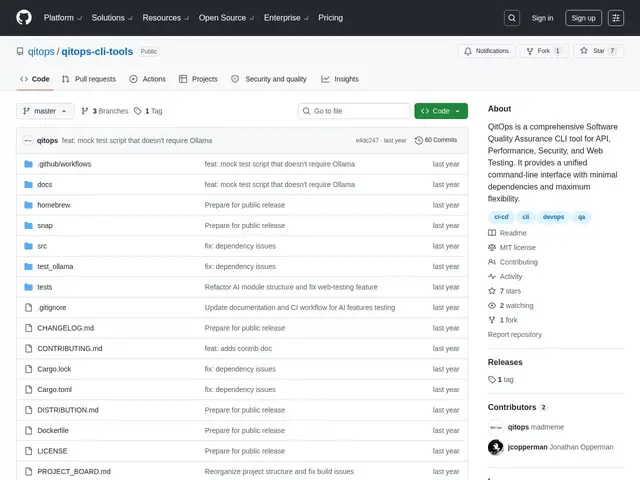
Description
Testing a piece of software properly usually means using several different tools: one for hitting API endpoints, another for simulating heavy traffic, a third for checking basic security issues, and maybe a browser automation script for the web interface. Switching between all of them, each with its own syntax and quirks, wastes time and makes it easy to miss something. QitOps is a single command-line tool, written in Rust, that does all four jobs at once.
QitOps is free and open-source under the MIT license, built to replace juggling Postman collections, k6 load-test scripts, custom curl chains, and browser test wrappers with one consistent interface. It handles API testing (single requests, request chaining, full collections with response validation and retries), performance/load testing (ramp-up profiles, percentile calculations, multi-scenario support), security scanning (headers, SSL, basic vulnerability and sensitive-data checks), and headless-browser web testing, all with data-driven testing from CSV or JSON files and CI/CD-ready output in JSON, XML, HTML, or CSV. It even includes optional AI-powered features — test generation, result analysis, and improvement suggestions — with support for local LLMs (Ollama, Mistral, LLaMA) so teams can use the AI features fully offline without sending data to a cloud API.
💬 Our review
The short version: QitOps is a genuinely useful idea — one CLI instead of four separate testing tools — but at 7 GitHub stars it's an early, unproven project, so treat it as worth experimenting with rather than something to bet a production QA pipeline on just yet.
Against the status quo of Postman for API testing, k6 for load testing, and separate security/browser tools, QitOps's pitch is consolidation: fewer tools to learn, fewer context switches, one CI/CD integration point instead of several. That's a real time-saver if it works reliably across all four domains, but each individual competitor (Postman, k6, JMeter) has years of production hardening that a young unified tool can't match yet. The local-LLM AI features are a genuinely differentiated touch — most competitors either have no AI features or require sending data to a cloud API — but they're also unproven at this stage. Given it's free and MIT-licensed, the downside of trying it is low; the risk is entirely about maturity, not cost. Worth a pilot on a non-critical project before replacing an established testing stack.
💰 Pricing
📊 Global score
🤖 AI-enriched data
Licence MIT, entièrement gratuit, aucun palier payant.
Pros
Un seul CLI pour API, performance, sécurité et tests web
Gratuit, open source, licence MIT
Support LLM local (Ollama, Mistral, LLaMA) pour usage IA hors-ligne
Intégration CI/CD prête à l'emploi, plusieurs formats de rapport
Cons
Seulement 7 étoiles GitHub — projet jeune, peu éprouvé en production
Pas de date de fondation publique
Concurrents (Postman, k6, JMeter) bien plus matures et éprouvés
Documentation et communauté encore limitées