mcp2cli
A free open-source tool that turns any MCP server, OpenAPI spec, or GraphQL endpoint into a plain command-line tool, so an AI coding agent can call it using far fewer tokens than the usual way.
🔗 Visit mcp2cli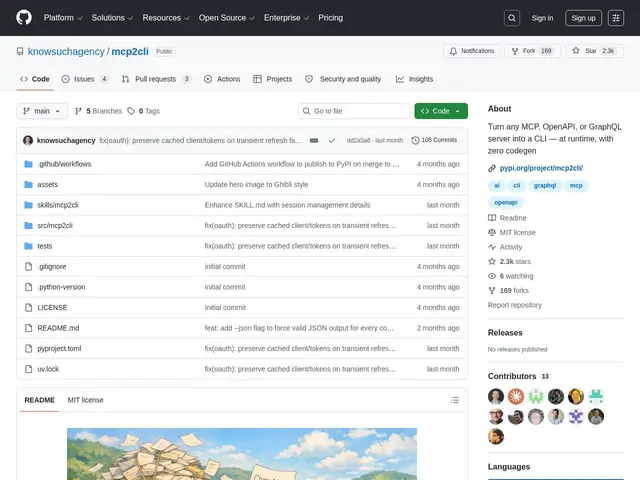
Description
When an AI coding assistant connects to an external tool through the Model Context Protocol (MCP), it normally has to read a description of every single feature that tool offers, every single time it starts a conversation. If that tool has dozens of features, that's a lot of wasted space before the assistant has even done anything useful. mcp2cli fixes this by converting any MCP server — or a regular OpenAPI/GraphQL API — into an ordinary command-line program, the same kind of program you'd run by typing a command and pressing enter.
mcp2cli is a free, open-source, MIT-licensed Python tool built specifically for how AI coding agents (Claude Code, Cursor, Codex) actually work: instead of loading a tool's entire schema into context on every turn, the agent runs `mcp2cli <command> --help` only when it needs to, which the maintainers claim saves 96-99% of the tokens normally spent on tool schemas. It supports MCP servers over HTTP/SSE or local stdio, plus OpenAPI and GraphQL endpoints directly, handles OAuth 2.1 authentication (including PKCE) with encrypted token storage, offers a token-efficient "TOON" output format alongside JSON, and includes a "bake" mode to save connection settings so you don't reconfigure things every session. It's actively maintained (2.3k GitHub stars, 105+ commits, 96 tests) and ships an installable skill that teaches coding agents how to use it automatically.
💬 Our review
The short version: if you're running AI coding agents against MCP servers with more than a handful of tools, mcp2cli's token savings alone likely pay for the five minutes it takes to set it up — and since it's free and open source, there's little downside to trying it.
Against the alternative of just letting an agent talk to an MCP server natively, mcp2cli's advantage is almost entirely about token economics: native MCP tool schemas get reloaded into context repeatedly, while a CLI's `--help` output is read on demand. Against similar OpenAPI-to-CLI converters like openapi-to-cli or openapi-mcp-generator, mcp2cli's edge is breadth — it handles MCP, OpenAPI, and GraphQL through one consistent interface, plus OAuth handling and usage-aware tool ranking that those narrower tools don't offer. The tradeoff is that it's still a young, single-maintainer project (2.3k stars is healthy but not enterprise-scale), so teams with strict support requirements should expect to self-support via GitHub issues rather than a vendor SLA. For solo developers and small teams already using MCP-connected agents daily, it's a low-risk, high-value addition.
💰 Pricing
📊 Global score
🤖 AI-enriched data
Licence MIT, entièrement gratuit, aucun palier payant.
Pros
Gratuit, open source, licence MIT
Réduction de tokens revendiquée de 96-99% face au MCP natif
Supporte MCP, OpenAPI ET GraphQL dans un seul outil
Gestion OAuth 2.1/PKCE intégrée, tokens chiffrés
2,3k étoiles GitHub, développement actif
Cons
Projet maintenu par un seul développeur, pas de support commercial
Pas de date de fondation publique
Nécessite de comprendre le fonctionnement CLI/MCP pour en tirer parti
Écosystème encore jeune comparé aux clients MCP natifs bien établis