Ratel
An open-source tool that stops AI agents from choking on too many tools and instructions by only loading the few that are relevant to what the agent is doing right now.
🔗 Visit Ratel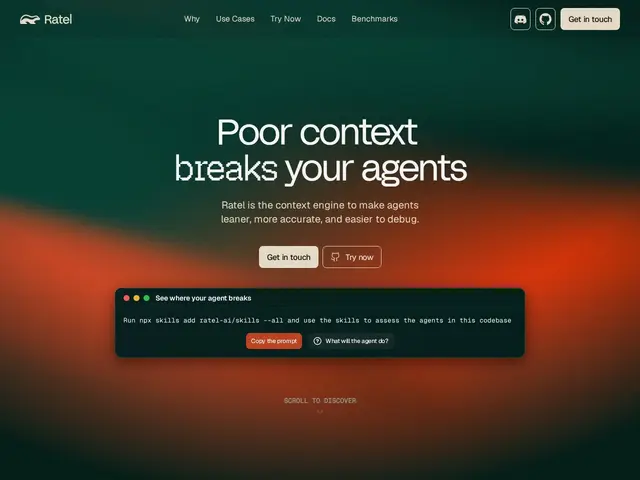
Description
Give an AI agent 200 tools and long instructions for every one of them, and it doesn't get smarter, it gets worse: it starts picking the wrong tool or forgetting what it's doing, simply because there's too much noise in its working memory. Ratel fixes this by acting like a smart filing cabinet: instead of dumping every tool description into the prompt, it searches a catalog and hands the agent only the handful of tools and skills relevant to the current step.
Ratel is an open-source context gateway for AI agents. It indexes your tools, skills, and MCP servers into a searchable catalog (BM25 keyword search by default, with optional semantic/hybrid ranking), and progressively discloses only what's relevant per turn instead of loading the full catalog into the prompt every time. It claims roughly 80% fewer tokens spent on tool definitions and improved task accuracy since the agent isn't distracted by irrelevant options. It requires no vector database or external service — the engine (written in Rust) runs in-process, with SDKs for TypeScript and Python, plus OpenTelemetry spans for observability. It's dual-licensed (Apache-2.0 for the core engine, MIT for SDKs/examples), free and open-source, published in July 2026 with 349 GitHub stars at time of writing — a genuinely new project without an established track record yet.
💬 Our review
The short version: if you've built (or are building) an agent with dozens of tools and you're watching accuracy drop as the tool list grows, Ratel is solving a real, well-documented problem, and being free, zero-infrastructure, and open-source makes it low-risk to try.
Compared to just stuffing everything into the system prompt (the default in most agent frameworks), Ratel's progressive disclosure is a straightforward accuracy and cost win once your tool catalog grows past a handful of entries. Compared to vector-DB-based retrieval approaches, Ratel's BM25-first, no-infrastructure design is simpler to deploy and debug, though keyword search can miss semantically-related-but-differently-worded tools that a vector embedding would catch — Ratel does offer optional semantic ranking to cover that gap. The real risk is maturity: this shipped in July 2026, has a three-digit star count, and no visible funding or company behind it beyond the open-source repo, so treat it as a promising early bet rather than a battle-tested dependency for a critical production agent just yet.
💰 Pricing
📊 Global score
🤖 AI-enriched data
Moteur (Rust) sous licence Apache-2.0, SDKs (TS/Python) sous MIT — entièrement gratuit, aucune infrastructure externe requise
Pros
~80% de tokens en moins sur les définitions d'outils (chiffre annoncé)
Aucune infrastructure externe requise (pas de vector DB)
SDKs TypeScript et Python, moteur Rust
Open-source, gratuit
Cons
Projet très récent (juillet 2026), peu d'historique
BM25 par défaut peut rater des correspondances sémantiques (ranking sémantique en option)
Pas d'entreprise ou financement visible derrière le projet
Communauté encore petite (349 étoiles GitHub)