Credyt
Billing infrastructure built for AI products, it tracks what each customer's AI usage actually costs in real time and lets you bill for it before you lose money on a runaway request.
🔗 Visit Credyt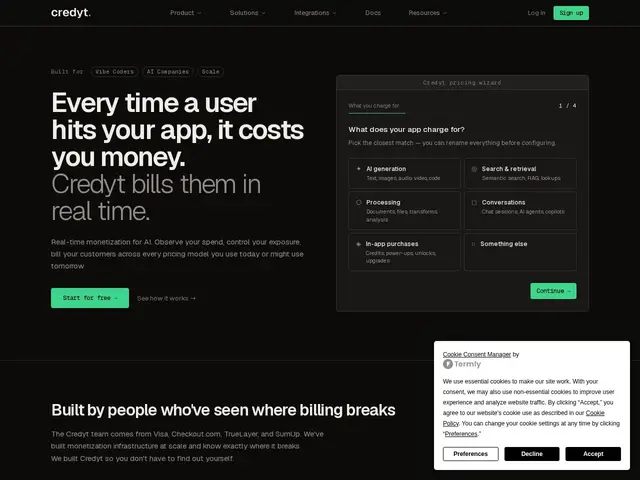
Description
If you've ever shipped an AI feature and only found out a week later that one customer's usage burned through your entire margin on API costs, that's the exact problem Credyt is built to prevent. It watches AI spending per customer as it happens, can hard-stop a request before it goes over a budget you set, and turns all of that into a bill your customer actually understands, whether you charge by usage, by seat, by subscription, or some mix of all three.
Credyt is billing infrastructure aimed at AI-native companies, from solo founders shipping with Claude Code or Cursor up through Series B+ teams that need profitability visibility, who need cost tracking and monetization for AI products where usage (and cost) is unpredictable by nature. It streams cost data per API call, model, and customer in real time, enforces hard budget ceilings with pre-authorization checks (stopping a request before it overspends rather than billing after the fact), and supports usage-based, subscription, hybrid, credit-based, and seat-based pricing simultaneously, with claimed atomic processing around 10ms. It integrates with Claude Code, Cursor, Lovable, Bolt, and Stripe, and exposes webhooks, an OpenAPI spec, SDKs, and MCP server support. Pricing is free to start, then $1 per active customer wallet per month with no revenue percentage taken and no long-term commitment. The team's background is Visa, Checkout.com, TrueLayer, and SumUp, and the product evolved from an earlier platform called Revenew that reportedly analyzed $1B/month in revenue at its peak, a meaningful signal of payments-domain experience even though the current product is comparatively new.
💬 Our review
The short version: for an AI product with real per-customer cost variance, Credyt's real-time, pre-authorization billing is solving a specific and painful problem that generic billing tools weren't built for, and the flat $1-per-wallet pricing with no revenue cut is genuinely competitive if you have real customer volume.
Against Stripe Billing, which most AI startups reach for by default, Credyt's edge is the pre-authorization budget enforcement (stopping a request before it blows a cost ceiling) and native multi-model-provider cost tracking, neither of which Stripe Billing does out of the box. Against dedicated usage-billing platforms like Metronome, Orb, or Lago, Credyt is narrower and newer but claims faster atomic processing (~10ms) and a simpler flat per-wallet fee instead of the percentage-of-revenue or enterprise-negotiated pricing those tools often carry, which matters a lot once you're at meaningful volume: $1/wallet/month stays predictable, a revenue cut doesn't. The catch is that Credyt itself is young (evolved from Revenew, no public founding date for the current product), so the "10ms atomic processing" and integration depth are still worth stress-testing against your own traffic before routing all customer billing through it, and companies without real per-customer AI cost variance won't get much value from what's a fairly specialized tool.
💰 Pricing
📊 Global score
🤖 AI-enriched data
Gratuit pour démarrer, puis 1$ par portefeuille client actif par mois, aucun pourcentage sur le revenu, sans engagement long terme
Pros
Suivi des coûts en temps réel par appel API, modèle et client
Plafonds budgétaires avec pré-autorisation (bloque avant dépassement, pas après)
Supporte usage/abonnement/hybride/crédit/siège simultanément
Tarif fixe (1$/portefeuille) sans pourcentage sur le revenu, prévisible à volume
Équipe issue de Visa, Checkout.com, TrueLayer, SumUp
Cons
Produit jeune, pas de date de fondation publique pour la version actuelle
Traitement "~10ms" et profondeur d'intégration à vérifier sur son propre trafic avant généralisation
Utile seulement si coûts IA réellement variables par client — sinon Stripe Billing suffit
Marché des concurrents (Metronome, Orb, Lago) plus établi