Aura
An open-source layer on top of Git that checks whether an AI coding agent's changes actually match what you asked for, before you commit them.
🔗 Visit Aura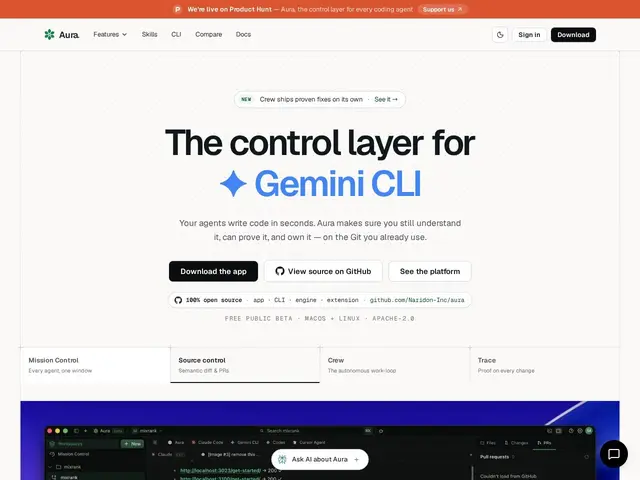
Description
AI coding agents like Claude Code, Cursor, or Copilot can write a lot of code very fast — the problem is verifying that what they wrote actually does what you asked, rather than something that merely looks plausible and passes a glance. Aura sits between the agent and your Git history: it tracks every change down to the individual function or class, compares the result against the intent you originally stated, and gives you a way to confirm a task was genuinely completed before that code becomes part of your codebase.
Aura is an open-source (MIT-licensed) Git-native review layer built specifically for teams running AI coding agents in production workflows. Rather than reviewing a diff and hoping it's correct, it tracks provenance at a granular level and flags where an agent's output diverges from the stated task, giving reviewers a faster, more targeted way to catch hallucinated or incomplete changes. The GitHub organization (AuraHQ-ai) also describes a broader agent-integration layer — persistent memory, Slack-based collaboration, and connectors to services like E2B, Tavily, ElevenLabs, Twilio, and Browserbase — suggesting the project spans both a focused Git-review tool and a wider agent-orchestration toolkit; the public homepage emphasizes the Git-native positioning. No pricing is published, consistent with an open-source project; it's built on TypeScript, Node.js, the Hono framework, and PostgreSQL, and was actively updated as of late July 2026.
💬 Our review
The short version: if your team ships code through AI coding agents and worries about unreviewed, plausible-looking-but-wrong changes sneaking into production, Aura is a purpose-built safety net worth trying, especially since it's free and open source.
The genuinely useful idea here is function/class-level provenance tracking tied to stated intent — most teams currently review AI-agent output the same way they review human PRs, which misses the specific failure mode of an agent confidently producing code that doesn't do what was asked. That said, the project is young (per its own GitHub repo: 1 star, 4 forks at last check, 90 open issues, 52 PRs), so treat it as an early-stage tool rather than a mature, battle-tested one — expect rough edges and a smaller community than established code-review tooling. There's also a real mismatch between the marketing site's Git-native-IDE framing and the GitHub repo's own description of a Slack-based AI teammate, which makes it hard to know exactly what you're adopting without trying it directly. Best fit: teams already comfortable running pre-1.0 open-source infrastructure who want an extra check on AI-agent output. Less appropriate for teams wanting a stable, well-documented, vendor-supported product today.
💰 Pricing
📊 Global score
🤖 AI-enriched data
Open source sous licence MIT, aucun tarif payant publié
Pros
Suivi des changements au niveau fonction/classe, pas juste le diff global
Compare le code produit à l'intention déclarée avant commit
Gratuit et open source (licence MIT)
Conçu spécifiquement pour les workflows avec agents de code IA
Cons
Projet jeune, peu d'étoiles/communauté sur le repo GitHub à date
Incohérence entre le positionnement du site (Git-native IDE) et la description du repo (coéquipier IA sur Slack)
Pas de tarification Enterprise publiée pour un usage à plus grande échelle
Documentation et maturité encore limitées