Statewave
A free, open-source memory system for AI agents that remembers things the same reproducible way every time — instead of the usual approach where an agent's memory changes slightly each time it searches, which makes its behavior hard to trust or audit.
🔗 Visit Statewave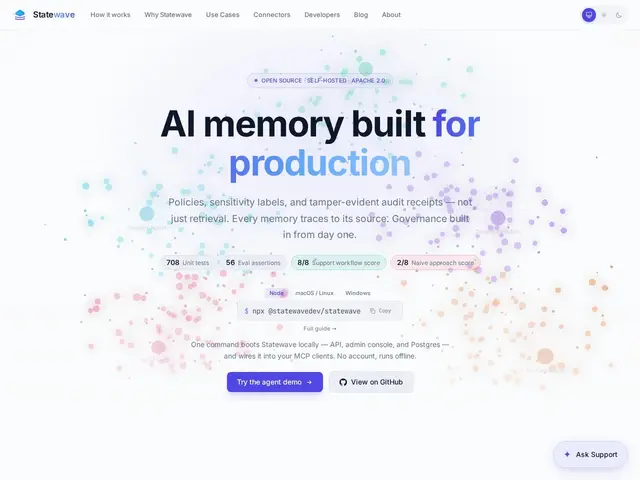
Description
AI agents that are supposed to remember past conversations usually work by searching a database of old messages each time they need context — and that search can return slightly different results run to run, which means the agent's "memory" isn't really consistent or auditable. Statewave takes a different approach: instead of re-searching every time, it builds structured, provenance-tagged "context bundles" that are reproducible, so you can see exactly what the agent remembered and why, every time.
Statewave is an Apache 2.0 licensed, open-source memory runtime (284 GitHub stars) built on Python 3.11+ and PostgreSQL 14+ with pgvector, requiring no GPU. It provides episodic and semantic memory with ranked, token-bounded retrieval, plus governance features aimed squarely at compliance-conscious teams: sensitivity labels, policies, HMAC-SHA256 signed state-assembly receipts for audit trails, multi-tenant isolation via header-scoped data separation, and region pinning for data residency requirements. It ships Python and TypeScript SDKs, a one-command local setup with API, admin console and database, Docker/Kubernetes deployment, a REST API supporting 100+ LLM providers via LiteLLM, and pre-built connectors for GitHub, Slack, Discord, Notion and email. It's currently at v1.4.0 with 56 test assertions across 23 integration tests.
💬 Our review
The short version: for teams building AI agents in regulated or compliance-sensitive contexts who need to prove what an agent remembered and why, Statewave's audit-and-governance-first design is a meaningfully different value proposition than most memory frameworks — and it's free.
Against Mem0 or Zep, which focus primarily on making agent memory work well and fast, Statewave's differentiator is treating memory as something that needs to be provably reproducible and auditable, not just functionally useful — the signed receipts and sensitivity labels are aimed at teams that will eventually need to answer "what did the agent know and when" to an auditor or regulator. Against LangChain's built-in memory modules, which are more of a convenience layer inside a broader framework, Statewave is a dedicated, self-hosted service you run alongside your agent stack, which means more infrastructure to operate (Postgres, Docker) in exchange for governance you'd otherwise have to build yourself. At 284 GitHub stars it's still an early project without the multi-year track record of Mem0 or LangChain, so expect fewer community examples when you hit an edge case — but for the specific compliance use case it targets, there isn't an obvious more mature free alternative.
💰 Pricing
📊 Global score
🤖 AI-enriched data
Licence Apache 2.0, auto-hébergé sur PostgreSQL, aucun coût de licence.
Pros
Mémoire reproductible et traçable (provenance), pas de bruit de recherche à chaque requête
Gouvernance intégrée : labels de sensibilité, reçus signés HMAC-SHA256, isolation multi-tenant
Gratuit, open source sous licence Apache 2.0
Connecteurs prêts à l'emploi (GitHub, Slack, Discord, Notion, email) et compatible 100+ fournisseurs LLM via LiteLLM
Cons
Nécessite d'opérer sa propre infrastructure (PostgreSQL, Docker)
Projet encore jeune (284 étoiles GitHub), moins de retours communautaires que les alternatives établies
Cible spécifiquement la conformité — complexité superflue si ce besoin n'existe pas