Retrace
A debugging tool for AI agents that lets you rewind a failed run to the exact step that broke, change one thing, and replay it — so you can actually prove a fix worked instead of just hoping it did.
🔗 Visit Retrace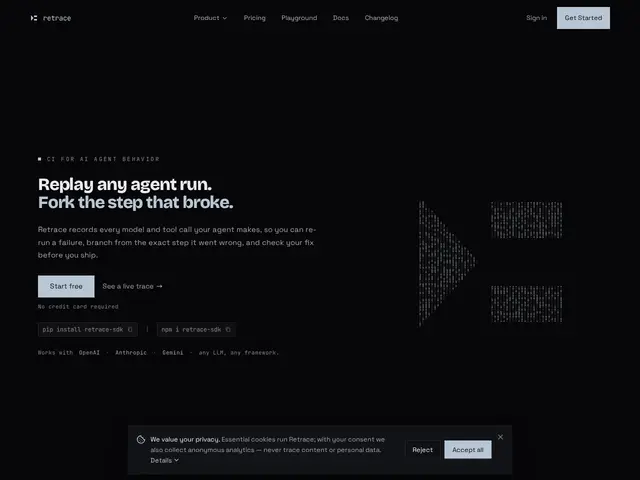
Description
AI agents fail in confusing ways: something goes wrong three tool calls deep, and by the time you notice, you have no clean way to see exactly what the agent was thinking or doing at that moment, let alone confirm your fix actually solves it. Retrace records everything an agent does — every AI call, every tool use, every error — with a single line of code, then lets you rewind to any point in a failed run, fork it, tweak the input, and replay it to see whether the outcome improved, regressed, or stayed the same.
Retrace ships Python and TypeScript SDKs with a single decorator for instrumentation, and integrates with LangChain, CrewAI, LlamaIndex, Vercel AI SDK and AutoGen, across OpenAI, Anthropic and Google Gemini models. Beyond replay-and-fork debugging, it adds runtime guardrails (cost budgets, loop detection, latency caps), an auto-classified failure taxonomy, causal graphs for tracing multi-agent sessions, and CI/CD quality gates via GitHub Actions that can block a regression from shipping — effectively turning each production failure into a permanent regression test. Data is encrypted in transit (TLS) and at rest (AES-256-GCM), with automatic PII redaction. Setup is claimed to take about two minutes, and the free tier (1,000 traces/month, 7-day retention) requires no credit card.
💬 Our review
The short version: if you're shipping AI agents to production and currently debugging failures by staring at raw logs, Retrace's replay-and-fork workflow is a meaningfully better way to work, and the free tier is generous enough to validate that before paying anything.
Against LangSmith or Langfuse, which focus more on tracing and evaluation dashboards, Retrace's specific edge is the fork-and-replay mechanic — actually re-running a failed step with a tweak and getting a pass/fail verdict, rather than just visualizing what happened. That's a genuinely useful workflow difference, not just a UI skin. The tradeoffs are pricing (Starter at $29/month for 10,000 traces will feel tight for a team with real production traffic, and jumping to Pro at $99/month is a big step) and the fact that it's a newer, narrower tool than the established observability platforms, so expect a smaller ecosystem of integrations and community examples. For solo builders and small teams specifically fighting flaky agent behavior, it's worth the $29/month; larger teams should compare total cost against LangSmith's usage-based pricing before committing.
💰 Pricing
📊 Global score
🤖 AI-enriched data
Gratuit (1000 traces/mois, rétention 7 jours), Starter 29$/mois (10 000 traces), Pro 99$/mois (50 000 traces), Teams 399$/mois (500 000 traces, 10 utilisateurs), Enterprise sur devis.
Pros
Rejoue et bifurque depuis n'importe quelle étape d'une exécution échouée
Verdict clair (amélioré/régressé/inchangé) après un correctif
Transforme chaque échec en test de régression pour la CI/CD
Chiffrement TLS + AES-256-GCM et rédaction automatique des PII
Cons
Palier Starter (29$/mois, 10 000 traces) vite limité pour une équipe en production
Écosystème d'intégrations plus restreint que les plateformes d'observabilité établies
Outil plus récent avec moins de retours d'expérience communautaires