Mozaik
A free, open-source toolkit for making several AI agents work together at the same time on a shared task, reacting to each other's progress in real time instead of waiting in a rigid, one-at-a-time pipeline.
🔗 Visit Mozaik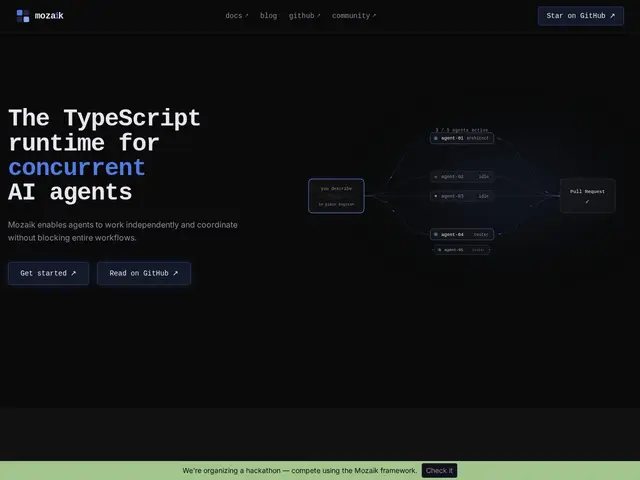
Description
Most multi-agent AI setups work like an assembly line: agent A finishes, then agent B starts, then agent C — each one waiting its turn. That's fine for simple tasks, but it breaks down when agents genuinely need to react to each other as things happen, the way a real team does. Mozaik is built for that second case: agents (and humans, and observers) all join a shared space, and every action — a message, a tool call, a mistake — becomes an event that any participant can react to immediately, without blocking the others.
Mozaik is an MIT-licensed, open-source TypeScript runtime (114 GitHub stars) built on Node.js, using an event-driven "agentic environment" architecture rather than predefined pipelines. Agents run inference and continue without waiting for a response, with results arriving as events other agents react to as everything else keeps running in parallel; the framework handles error routing, intelligent retries, lifecycle hooks for participants joining or leaving, and selective event filtering so agents only listen to what's relevant to them. It integrates with OpenAI, Anthropic Claude, Google Gemini and DeepSeek (via an OpenAI-compatible endpoint). Its own demo project, Baro, uses ten specialized agents — planners, executors, reviewers, auditors — working concurrently on shared goals through the Mozaik event bus, as a reference for what the framework is meant to enable. It's part of the broader JigJoy ecosystem.
💬 Our review
The short version: Mozaik is worth a look specifically if your multi-agent problem is genuinely parallel and reactive — if your agents actually just run in sequence, a simpler framework like LangGraph or CrewAI will be easier to reason about and better documented.
Compared to LangGraph, which models workflows as an explicit graph you define upfront, Mozaik's event-bus approach trades predictability for flexibility — agents can react to things you didn't explicitly wire together, which is powerful for emergent, team-like behavior but harder to debug when something goes wrong, since there's no single graph to trace through. CrewAI and AutoGen sit somewhere in between, offering role-based agent teams with more structure than Mozaik but less flexibility than raw event-driven design. Being free, MIT-licensed and open source is a real plus with no lock-in cost, but at 114 GitHub stars it's still an early project with a much smaller community and less battle-testing than LangGraph or CrewAI, so expect to read source code more often than documentation when you hit an edge case.
💰 Pricing
📊 Global score
🤖 AI-enriched data
Entièrement gratuit sous licence MIT, aucun palier payant, auto-hébergement via Node.js.
Pros
Coordination réellement parallèle entre agents, pas de pipeline séquentiel rigide
Gratuit et open source sous licence MIT
Compatible OpenAI, Anthropic, Gemini et DeepSeek
Architecture par événements flexible pour un comportement d'équipe émergent
Cons
Communauté et documentation encore limitées (114 étoiles GitHub)
Architecture événementielle plus difficile à déboguer qu'un graphe explicite
Moins éprouvé en production que LangGraph ou CrewAI