LangAlpha
An open-source AI research assistant for investing that actually runs code against real market data — building charts, DCF models and earnings analyses — instead of just chatting about stocks.
🔗 Visit LangAlpha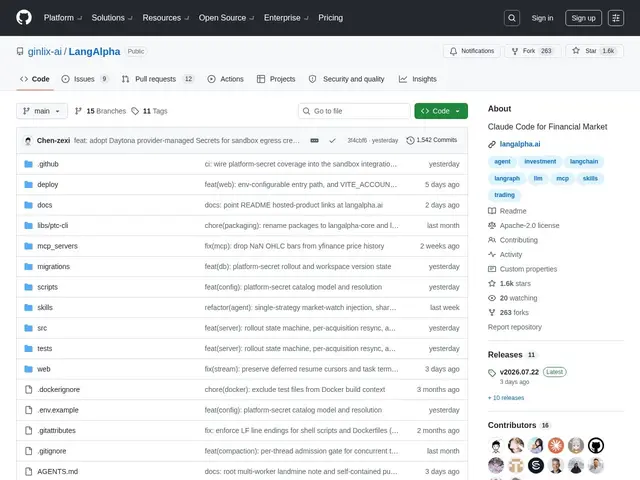
Description
Ask a general chatbot about a stock and it'll give you a plausible-sounding answer that might be outdated or simply made up, because it isn't actually looking at live numbers. LangAlpha was built to fix exactly that: it's described as "Claude Code, but for Wall Street" — an AI research assistant that writes and runs real Python code against live financial data and SEC filings, so its charts and calculations come from actual current data instead of the model's memory.
LangAlpha is an Apache 2.0 licensed, open-source multi-agent framework (1,600+ GitHub stars) built on LangGraph, with a Python 3.12+ backend and a React frontend. Instead of dumping raw data into the LLM's context, it uses a "Programmatic Tool Calling" approach where agents write and execute Python in sandboxed environments (Docker self-hosted, or Daytona cloud sandboxes), giving each research session a persistent workspace with 23 pre-built financial skills — DCF modeling, earnings analysis, competitive analysis — plus parallel async subagents, TradingView chart integration, and automation via cron scheduling or price-triggered alerts. It supports multiple LLM providers with automatic failover, integrates with Slack, Discord, Feishu and Telegram, and includes encryption at rest and credential leak detection. You can self-host it for free via Docker or use the hosted version at langalpha.ai (which redirects from ginlix.ai) on a freemium plan with daily usage caps.
💬 Our review
The short version: for anyone doing serious investment research who's comfortable with a bit of technical setup, LangAlpha is a genuinely different and more trustworthy approach than asking a general chatbot about stocks — the code-execution model means its outputs are checkable, not just plausible.
The honest comparison isn't really to ChatGPT (which doesn't reliably pull live data) but to dedicated platforms like QuantConnect (algorithmic backtesting, steeper learning curve, not conversational) or a Bloomberg Terminal (comprehensive but costs tens of thousands per year and is built for institutions, not individual researchers). LangAlpha's free, self-hosted, Apache-2.0 nature is a real strength against both — you own the deployment and aren't locked into a vendor. The catch is that self-hosting requires comfort with Docker and Python tooling, and the hosted free tier's daily caps will feel limiting for anyone doing this professionally, at which point you're evaluating it against paid plans whose exact pricing isn't broken out publicly. It's not a beginner's tool either — the value is in the code-execution transparency, which matters most to people who already know what a DCF model is.
💰 Pricing
📊 Global score
🤖 AI-enriched data
Auto-hébergement gratuit (licence Apache 2.0, Docker). Version hébergée sur langalpha.ai avec palier gratuit à quota quotidien limité, paliers payants avec clés API personnelles possibles.
Pros
Exécute du vrai code Python sur des données de marché en direct, pas de réponses inventées
Open source Apache 2.0, auto-hébergeable gratuitement via Docker
23 compétences financières préconstruites (DCF, analyse de résultats, analyse concurrentielle)
Intégration TradingView et automatisations par cron ou déclencheurs de prix
Cons
Auto-hébergement demande une aisance technique (Docker, Python)
Quotas quotidiens serrés sur le palier gratuit hébergé
Tarification des paliers payants non détaillée publiquement