Nimic
A way to write ordinary-looking Python code that can either run normally, or get compiled down to a fast, standalone native program — without switching languages.
🔗 Visit Nimic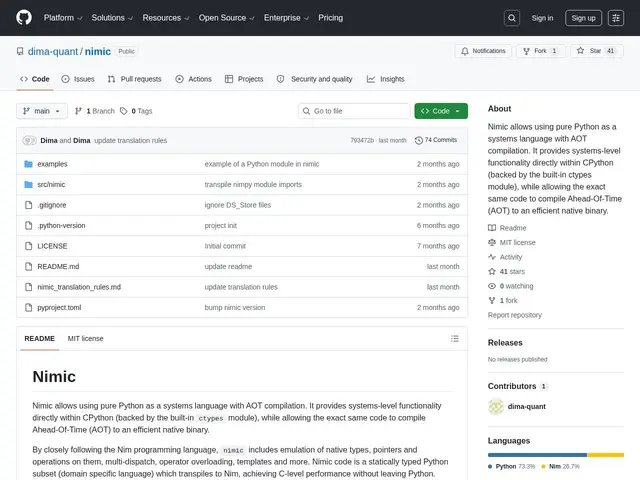
Description
Python is easy to write but famously slow for CPU-heavy work, which is why performance-critical code often gets rewritten in C, Rust, or another compiled language — a costly rewrite that splits a codebase in two. Nimic offers a middle path: you write a restricted subset of ordinary Python, and that same code can either run directly inside a normal Python interpreter for easy debugging, or get transpiled into the Nim programming language and compiled ahead-of-time into a fast native binary.
Nimic is a free, MIT-licensed, open-source Python module built on the ctypes standard library, closely following Nim's semantics so the transpilation is close to 1:1. It supports fixed-width numeric types, structs, enums, arrays and sequences, multi-dispatch with generics and operator overloading, pointer arithmetic, and compile-time templates and conditions — the kind of systems-programming features Python normally lacks. Because the same source runs unmodified in CPython if Nim compilation isn't available, teams can use it for gradual optimization: keep the code readable and debuggable as Python day-to-day, and compile the hot paths to native speed when it matters, without maintaining two separate implementations.
💬 Our review
The short version: Nimic is for a Python developer who's hit a performance wall on a specific hot function and doesn't want to learn Rust or C just to fix it — but it's a niche, early-stage tool, not a mainstream production dependency yet.
The dual-mode design — same source runs in CPython or compiles via Nim — is a genuinely clever answer to the "two codebases" problem that plagues most Python-to-native approaches, and leaning on Nim (itself Python-influenced in syntax) instead of inventing a new DSL from scratch is a sensible choice. The honest caveat: this is a young, single-maintainer-style project without the ecosystem, tooling, or battle-testing of established options like Cython (two decades of production use), mypyc, or Numba (which specifically targets numeric/array code with a huge scientific-Python user base). If you need a proven path to speeding up Python today, Cython or Numba are the safer default; if you're comfortable being an early adopter and want true systems-level features like pointers and structs that those tools don't offer, Nimic is worth experimenting with.
💰 Pricing
📊 Global score
🤖 AI-enriched data
Entièrement gratuit, licence MIT.
Pros
Le même code source tourne en Python normal ou compile en natif via Nim
Fonctionnalités systèmes réelles : pointeurs, structs, enums, templates
Gratuit et open source (MIT)
Pas besoin d'apprendre un nouveau langage pour le code critique
Cons
Projet jeune, écosystème et outillage limités comparé à Cython ou Numba
Nécessite Nim installé pour la compilation AOT
Sous-ensemble restreint de Python, pas du Python complet
Peu de retours de production à grande échelle pour l'instant