Giscus
A free comment box you can drop into any blog or website, that stores every comment as a normal GitHub Discussion instead of a database you have to maintain.
🔗 Visit Giscus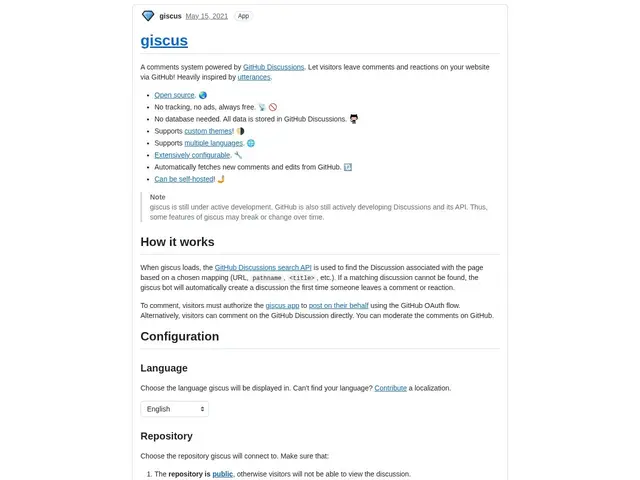
Description
Adding comments to a personal blog or documentation site usually means picking between a heavyweight service like Disqus — which tracks visitors and shows ads — or building your own comment database and moderation system from scratch. Giscus sidesteps both: it's a small widget you paste into your site that stores every comment as a real GitHub Discussion on a repo you choose, so GitHub does the hosting, moderation tooling, and spam handling for you, for free.
Giscus is a free, open-source (MIT licensed, 12,000+ GitHub stars) commenting system built with Next.js, React and TypeScript, directly inspired by the earlier project utterances. When a visitor comments, they authenticate via GitHub OAuth, and giscus automatically creates the corresponding Discussion thread on first use, matching pages to Discussions by URL, pathname, or title depending on configuration. It requires no separate database, shows no ads, does no tracking, and ships official component libraries for React, Vue and Svelte alongside the vanilla embed, plus theming and multilingual UI support. The tradeoff is that commenters need a GitHub account, which fits a developer-facing blog well but is a real barrier for a general consumer audience.
💬 Our review
The short version: giscus is the obvious default if you run a developer blog, documentation site, or personal site on GitHub Pages and want comments without running your own backend or handing visitor data to an ad-supported platform.
Building on GitHub Discussions instead of a custom database is the smart part — you inherit GitHub's spam handling, moderation tools, and reliability for free, and there's genuinely no ongoing infrastructure to maintain on your end. Being open source and ad-free also means no dark patterns and no vendor lock-in risk the way Disqus has burned developers before with ads and tracking creeping into a "free" widget. The real limitation is the GitHub-account requirement: it's a non-issue for a technical audience, but it will silently exclude anyone without a GitHub account, which rules giscus out for a general-audience blog, a food blog, or a small business site — Disqus, Commento or Cusdis don't have that barrier. If your readers are developers, giscus wins outright; if they're not, look elsewhere.
💰 Pricing
📊 Global score
🤖 AI-enriched data
Entièrement gratuit, licence MIT. Aucun coût caché, pas de version payante.
Pros
Entièrement gratuit et open source, aucune publicité ni tracking
Aucune base de données à gérer, tout est stocké dans GitHub Discussions
Bibliothèques de composants officielles React, Vue, Svelte
Modération et anti-spam hérités directement de GitHub
Cons
Exige un compte GitHub pour commenter — barrière forte pour un public non-technique
Pas adapté à un blog grand public ou un site e-commerce
Dépend entièrement de la disponibilité et des règles de GitHub