Phasr
A desktop app that lets you fire off several AI coding agents at once — each one working in its own isolated copy of the repo — and shows you exactly what each one changed before you let any of it touch your main branch.
🔗 Visit Phasr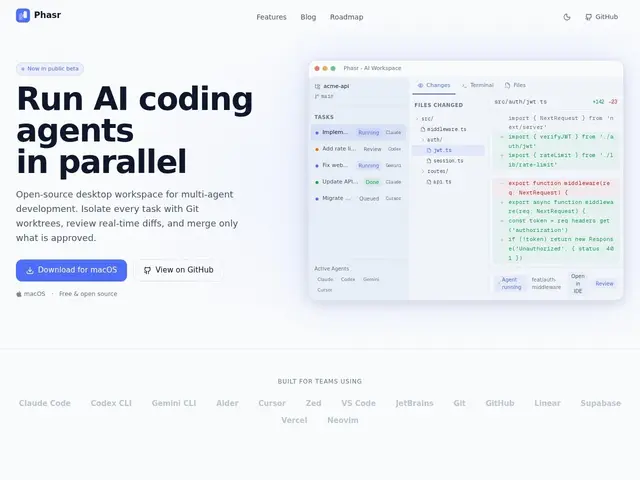
Description
Running two AI coding agents on the same task at the same time usually means they trip over each other's file edits, or you manually juggle branches to keep their work separate. Phasr's answer is to give every agent its own Git worktree automatically, so parallel work never collides, and to put a review screen between the agents and your main branch.
Phasr is an open-source (MIT) desktop workspace that runs any CLI-based AI agent — Claude, Codex, Gemini, Cursor, Aider or others — each in its own Git worktree with no shared working-directory conflicts, live status and progress tracking per agent, one-click deep links into VS Code, Cursor, JetBrains or Xcode to review generated code, and file-level diffs with an approval workflow before anything merges. It's agent-agnostic with no vendor lock-in, currently in public beta (since February-March 2026) as a macOS-only desktop app.
💬 Our review
The short version: Phasr solves a specific, real friction point — running several AI coding agents in parallel without them stepping on each other's files — using Git worktrees rather than heavier container-based isolation, and being free, open-source and agent-agnostic (works with Claude, Codex, Gemini, Cursor, Aider) means no lock-in to a single AI vendor.
Against rolling your own worktree setup by hand (a well-documented pattern, as the search results for this topic show), Phasr's value is the polish: live per-agent status, one-click IDE deep links, and a structured file-diff approval workflow, versus manually juggling terminal windows and `git worktree add` commands. It's early — public beta since roughly February 2026, no GitHub star count confirmed, and macOS-only at launch, so Linux or Windows users are out of luck for now, and there's no track record yet for how it holds up on large, messy monorepos. Worth trying if you already run multiple coding agents in parallel and are tired of manual worktree management; not worth the setup if you only ever run one agent at a time, where the isolation problem doesn't exist in the first place.
💰 Pricing
📊 Global score
🤖 AI-enriched data
Entièrement gratuit et open source sous licence MIT.
Pros
Gratuit et open source (MIT), aucun vendor lock-in
Agnostique vis-à-vis de l'agent : Claude, Codex, Gemini, Cursor, Aider
Isolation automatique via Git worktrees, pas de conflit de fichiers
Workflow de revue avec diffs par fichier avant merge
Cons
macOS uniquement au lancement, pas de Linux/Windows
Encore en bêta publique, peu de recul sur les gros monorepos
Pas de nombre d'étoiles GitHub confirmé
Utile seulement si plusieurs agents tournent réellement en parallèle