MCP Bridge
A translator that sits in front of your existing company APIs — the REST endpoints your backend already has — and automatically turns them into tools an AI agent like Claude or GPT can call, without anyone rewriting those APIs.
🔗 Visit MCP Bridge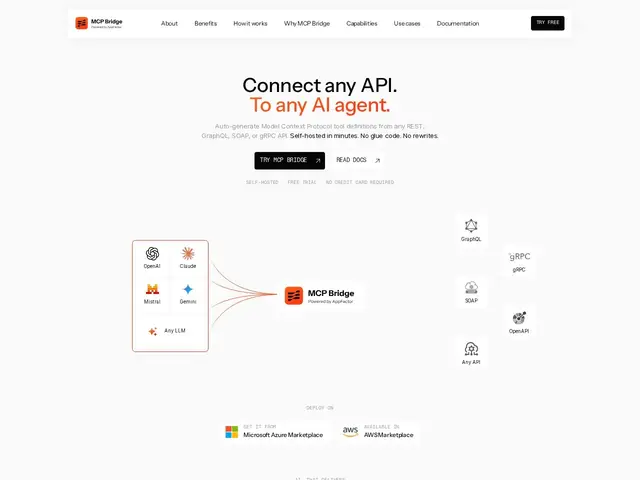
Description
AI agents are increasingly expected to actually do things inside a company's systems, not just answer questions, but most internal APIs weren't built with AI agents in mind and wiring each one up manually as an agent tool is slow, repetitive work. MCP Bridge automates that translation step: point it at an existing API and it generates the Model Context Protocol tool definitions for you.
MCP Bridge is a self-hosted, Rust-built proxy supporting REST, GraphQL, SOAP and gRPC APIs, generating MCP tools from OpenAPI 3, GraphQL schemas, WSDL or .proto files, with enterprise authentication (OAuth2, AWS Cognito, OIDC), an analytics dashboard tracking token usage, tool annotations, semantic search, and API response post-processing. Its "Code Mode" claims a 98% reduction in context consumption to cut LLM cost and latency, it's Docker-deployable and available via AWS and Azure Marketplace for enterprise rollout, and works across major LLM providers (Claude, OpenAI, Mistral, Gemini).
💬 Our review
The short version: MCP Bridge is solving the unglamorous but real problem of turning a company's existing API surface into agent-callable tools without hand-writing MCP definitions for every endpoint — schema-driven generation from OpenAPI/GraphQL/WSDL/.proto is the practical time-saver here.
Against manually building a custom MCP server per API (the default approach most teams take today), MCP Bridge's value is standardization across protocols — REST, GraphQL, SOAP and gRPC all handled through one proxy rather than bespoke code per API type — plus enterprise auth (OAuth2, Cognito, OIDC) built in, which matters once you're exposing internal systems to an agent rather than a public toy API. The claimed 98% context-consumption reduction from "Code Mode" is a vendor figure worth verifying against your own token usage rather than taking at face value, and pricing isn't public, so budget planning requires a sales conversation. Worth adopting if you have several existing internal APIs you want agent-accessible without a manual MCP-server-per-API effort; overkill if you're only exposing one simple API, where hand-writing a single MCP server is faster than adopting a new proxy layer.
💰 Pricing
📊 Global score
🤖 AI-enriched data
Essai gratuit disponible. Offres étagées via AWS/Azure Marketplace, de l'évaluation au déploiement entreprise. Tarification publique non détaillée.
Pros
Génération d'outils MCP automatique depuis OpenAPI/GraphQL/WSDL/.proto
Support de 4 protocoles API dans un seul proxy (REST, GraphQL, SOAP, gRPC)
Authentification entreprise intégrée (OAuth2, Cognito, OIDC)
Auto-hébergeable en Docker, disponible sur AWS/Azure Marketplace
Cons
Tarification publique non disponible
Chiffre de réduction de contexte (98%) à vérifier sur son propre usage, pas garanti
Overkill pour une seule API simple à exposer
Date de fondation non communiquée