Quackback
A place for customers to post feature requests and vote on them, with an open-source option so you can run the whole thing on your own servers instead of paying a SaaS forever for what is, underneath, a fairly simple voting board.
🔗 Visit Quackback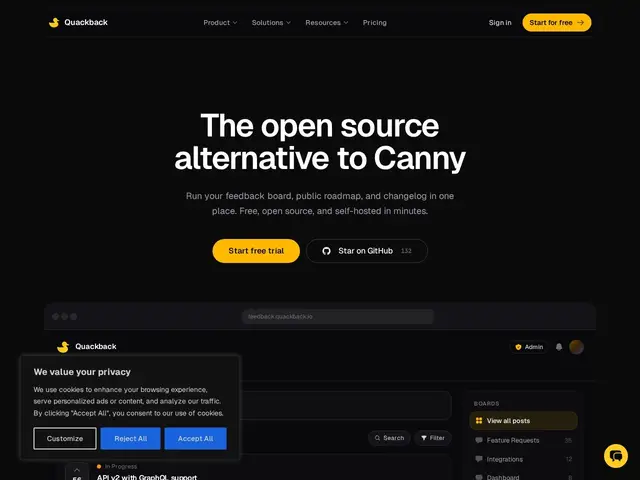
Description
Collecting feature requests without a system quickly turns into a scattered mess of Slack threads and support tickets that nobody revisits, but the tools that solve this — Canny being the best-known — are proprietary SaaS with no way to run them yourself. Quackback's pitch is to be the same category of tool, open source, so you can self-host it if you'd rather not pay a recurring fee or hand customer feedback data to a third party.
Quackback is an AGPL-3.0 open-source feedback platform with a public voting board, roadmap sharing, changelog and release-note publishing, AI-powered deduplication and sentiment analysis, a REST API with webhooks, Slack/email/support-ticket integrations, an embeddable widget with dark mode, and SSO/SAML for enterprise self-hosters. Cloud pricing runs $19/month (Starter) to $299/month (Scale) with a 14-day free trial, while the self-hosted version is free, and the project currently has 132 GitHub stars.
💬 Our review
The short version: Quackback's real differentiator against Canny is simple — the self-hosted, AGPL-licensed option exists at all, which means you can avoid both the recurring SaaS cost and the requirement to send customer feedback data to a third party's servers, something Canny doesn't offer.
Against ProductLift or ReleasePad — both closer to the pure changelog end of this space — Quackback covers more ground (voting board + roadmap + changelog in one), closer to a direct Canny clone than a specialized changelog tool. The tradeoff for that breadth is a smaller community and track record than Canny (132 GitHub stars is modest for an open-source project competing in this space), so expect fewer integrations and polish out of the box. Worth it if avoiding vendor lock-in and data residency are real concerns and you're willing to self-host; the $19-299/month cloud tiers are reasonable but don't beat Canny by enough on price alone to justify switching if you don't care about self-hosting.
💰 Pricing
📊 Global score
🤖 AI-enriched data
Auto-hébergé gratuit (AGPL-3.0). Cloud : Starter 19 $/mois, Pro 79 $/mois, Scale 299 $/mois. Essai gratuit 14 jours.
Pros
Option auto-hébergée gratuite sous licence AGPL-3.0, contrairement à Canny
Couvre votes + roadmap + changelog dans un seul outil
Déduplication et analyse de sentiment assistées par IA
Essai gratuit 14 jours sans carte bancaire
Cons
Communauté et recul plus modestes que Canny (132 étoiles GitHub)
Moins d'intégrations tierces qu'un acteur établi comme Canny
Auto-hébergement demande des compétences techniques et de la maintenance
Moins spécialisé que ReleasePad sur le changelog seul