ProductLift
A single board where customers suggest and vote on features, product managers score and prioritize what actually gets built, and — once it ships — every voter gets automatically notified, closing a loop that most teams handle across three or four disconne
🔗 Visit ProductLift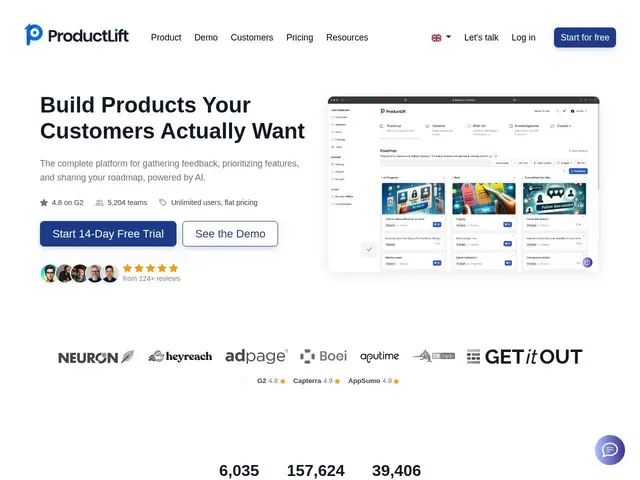
Description
Feature requests, prioritization decisions and "hey, we actually built the thing you asked for" announcements usually live in three separate tools that don't talk to each other, so customers who voted for something months ago never find out it shipped. ProductLift's pitch is to own the whole loop end to end so that closing it is automatic instead of a task someone forgets.
ProductLift combines feedback collection with automatic duplicate detection, AI-powered prioritization using RICE, ICE, MoSCoW and Impact/Effort scoring frameworks, a drag-and-drop roadmap builder with unlimited boards, Git2Log AI-generated changelogs pulled from commits, embeddable widgets, SSO, and integrations with Jira, Azure DevOps, HubSpot, Slack and Stripe across 22 languages. It's EU-hosted and GDPR-compliant, used by 5,204+ teams with a 4.8 G2 / 4.9 Capterra rating, prices from $19/month (Starter) to $199/month (Business) based on team-member seats only — every tier includes unlimited end-users who vote or comment — with a 14-day free trial and white-label included on all plans.
💬 Our review
The short version: ProductLift's "unlimited end-users on every tier" pricing model is the detail that matters most here — since you only pay for internal team seats, not for how many customers vote or comment, the cost stays predictable as your user base grows, unlike tools that charge per active end-user.
Against Quackback (which also bundles voting, roadmap and changelog but leans more toward being an open-source Canny clone) or ReleasePad (changelog-only, no prioritization scoring), ProductLift's differentiator is the built-in RICE/ICE/MoSCoW prioritization scoring — most competitors leave prioritization as a spreadsheet exercise outside the tool, while ProductLift tries to make the scoring itself part of the workflow. The 5,204+ team count and strong G2/Capterra ratings are a solid trust signal for a product in this specific niche. Worth it for a product team that wants feedback, structured prioritization and changelog notification in one workflow without per-end-user cost anxiety; if you only need automated changelogs and nothing else, ReleasePad is a narrower, cheaper fit.
💰 Pricing
📊 Global score
🤖 AI-enriched data
Starter 19 $/mois, Pro 79 $/mois, Business 199 $/mois (facturation annuelle, -30%). Utilisateurs finaux illimités sur tous les paliers, prix basé uniquement sur les sièges d'équipe. Essai gratuit 14 jours.
Pros
Utilisateurs finaux illimités sur tous les paliers — le prix ne grimpe pas avec la base de votants
Priorisation intégrée avec des frameworks reconnus (RICE, ICE, MoSCoW, Impact/Effort)
Notification automatique des votants quand une fonctionnalité ship
Hébergé en UE, conforme RGPD, marque blanche incluse sur tous les plans
Cons
Plus cher à l'entrée que Quackback en self-hosted (gratuit) ou ReleasePad ($35/mois)
Fonctionnalités de priorisation avancées qui demandent un temps d'adoption
Pas d'option auto-hébergée contrairement à Quackback
Business à 199 $/mois reste significatif pour une petite équipe