Solvimon
Billing infrastructure built by the team that ran Adyen's internal billing engine at trillion-euro scale, aimed at companies whose pricing is a messy mix of seats, usage and credits and who are heading toward an IPO-grade finance stack.
🔗 Visit Solvimon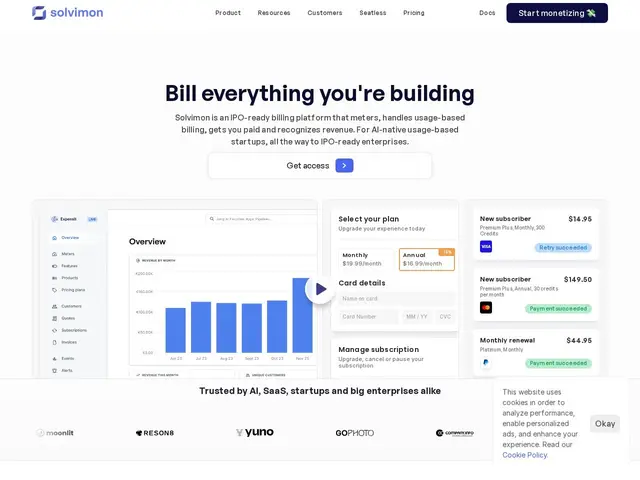
Description
Most billing tools are built for one pricing model — seats, or usage, or credits — and force you to bolt on workarounds when your business needs a mix. Solvimon's pitch is that hybrid pricing (some seats, some usage, some prepaid credits, all on the same customer) should be the default case, not an edge case requiring custom engineering.
Solvimon is a billing and quote-to-cash platform founded by ex-Adyen engineers who built that company's internal billing system processing roughly €1 trillion annually, designed to handle 1M transactions per second and pass IPO-grade financial scrutiny. It combines metering, CPQ, multi-currency payments, global revenue recognition, and tax/FX handling through a single ledger, with 30+ integrations across PSPs, ERPs and CRMs, mid-cycle billing adjustments, and an AI/MCP/CLI layer for modern engineering stacks. Pricing starts near €14.95/month plus per-event fees from €0.0099 declining with volume, and AI startups get the first $3M in billed volume free.
💬 Our review
The short version: Solvimon's pedigree — the team that built Adyen's own billing engine — and its explicit target of IPO-scale financial rigor make it a genuinely different pitch from most billing startups in this space: built for scale and audit-readiness from day one, not retrofitted later.
Against Alguna or Zenskar (both younger, more self-serve, no-code-first), Solvimon leans enterprise-grade: it advertises 1M TPS capacity and Fortune 500-through-Series-A customers like Just Eat Takeaway and SEON, which is reassuring if you expect to scale hard, but is also more infrastructure than a five-person startup needs on day one. The free-first-$3M offer for AI startups is a real incentive to trial it cheaply, and the per-event pricing (from €0.0099, declining with volume) is transparent compared to Sequence's demo-only, undisclosed pricing. Worth it if hybrid pricing (seats+usage+credits together) is genuinely your reality and you expect serious scale; overkill if you're a small SaaS with one simple subscription tier, where Schematic or a plain Stripe Billing setup is cheaper and simpler.
💰 Pricing
📊 Global score
🤖 AI-enriched data
Abonnement de base ~14,95 €/mois + frais dégressifs à partir de 0,0099 €/événement. Premiers 3M$ de volume facturé gratuits pour les startups IA.
Pros
Fondé par l'équipe qui a bâti le moteur de facturation interne d'Adyen (~1 000 Md€/an)
Conçu pour 1M TPS et la rigueur financière niveau IPO
Tarification par événement transparente et publique, contrairement à des concurrents sur devis uniquement
Premiers 3M$ de volume gratuits pour les startups IA
Cons
Plus d'infrastructure que nécessaire pour une petite équipe avec une tarification simple
Produit récent (2026), MRR encore modeste ($5,8M) malgré la croissance forte (+43% YoY)
Frais par événement qui s'accumulent vite à très grande échelle sans négociation
Positionnement enterprise qui suppose déjà une complexité de pricing réelle