Schematic
A plan that tells your app in real time who's allowed to use which feature, so a product team can turn a paywall on or off without filing an engineering ticket.
🔗 Visit Schematic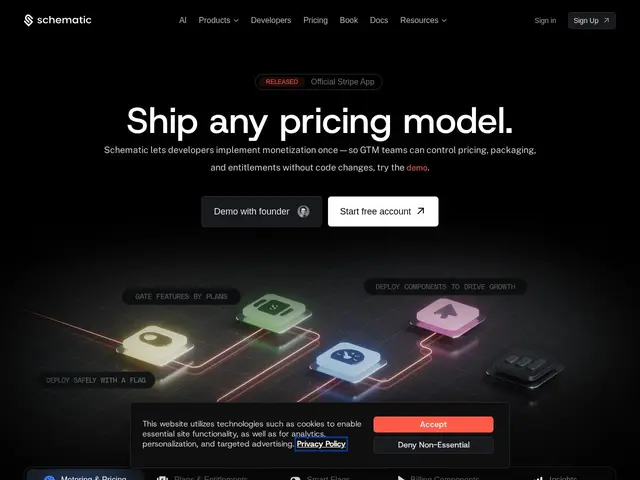
Description
Every SaaS product eventually hits the same wall: someone in sales wants to gate a feature behind a higher plan, or launch a trial with different limits, and the answer is always "that's a two-week engineering job." Schematic exists to make that answer "a five-minute change in a dashboard" instead, by moving who-can-access-what out of your codebase and into a config you can edit without redeploying anything.
Schematic is a monetization layer built on top of Stripe (not a replacement for it) that handles metering, entitlements, and feature flags together: flat-fee, seat-based, usage-based and credit-burndown pricing models, sub-50ms feature-flag evaluation, and drop-in React components for pricing tables and checkout. It ships SDKs for React, Node.js, Go, Python, Java and C#, is a Stripe Verified Partner requiring no billing migration, carries SOC II/AICPA compliance, and is used in production by companies like BigCommerce, Plotly and Automox.
💬 Our review
The short version: Schematic doesn't try to replace Stripe, and that's its main selling point — if you already bill through Stripe and your actual pain is "engineering has to ship code every time pricing changes," this is a narrower, cheaper fix than a full monetization platform.
Against Alguna, Sequence or Zenskar — which all try to own the entire quote-to-cash flow including CPQ and revenue recognition — Schematic deliberately stays in its lane: entitlements, feature flags, and metering on top of a Stripe account you keep. That focus means a much lighter integration (Stripe Verified Partner, no billing migration) and a genuinely useful free tier (10 subscriptions, 500K events) to validate before paying, versus Alguna's $699/month Growth plan or Sequence's demo-only pricing. The tradeoff is real: if what you actually need is CPQ, multi-currency revenue recognition, or you're not already on Stripe, Schematic doesn't cover that ground and you'll end up buying a second tool anyway. Worth it for teams whose specific bottleneck is "pricing changes require an engineering sprint"; skip it if your billing pain is upstream of Stripe (contracts, quoting, revrec).
💰 Pricing
📊 Global score
🤖 AI-enriched data
Gratuit jusqu'à 10 abonnements et 500K événements/mois. Growth à 200 $/mois (100 abonnements, 10M événements). Add-on Teams à 500 $/mois. Enterprise sur devis avec paliers de volume.
Pros
Ne remplace pas Stripe, s'y greffe — zéro migration de facturation
Feature flags + entitlements évalués en moins de 50ms
Palier gratuit généreux (10 abonnements, 500K événements) pour valider avant de payer
SDKs pour 6+ langages/frameworks, composants React prêts à l'emploi
Cons
Dépend de Stripe comme processeur de paiement sous-jacent, pas une solution autonome
Ne couvre pas la reconnaissance de revenus ni le CPQ comme Alguna ou Sequence
Prix Growth (200 $/mois) grimpe vite si le volume d'événements dépasse 10M
Pas de date de fondation communiquée, difficile de juger la maturité