Tabstack
A service that reads and interacts with web pages for you — pulling structured data, converting pages to clean text, or automating a browser task — through a simple API call, without you having to run and maintain your own scraper.
🔗 Visit Tabstack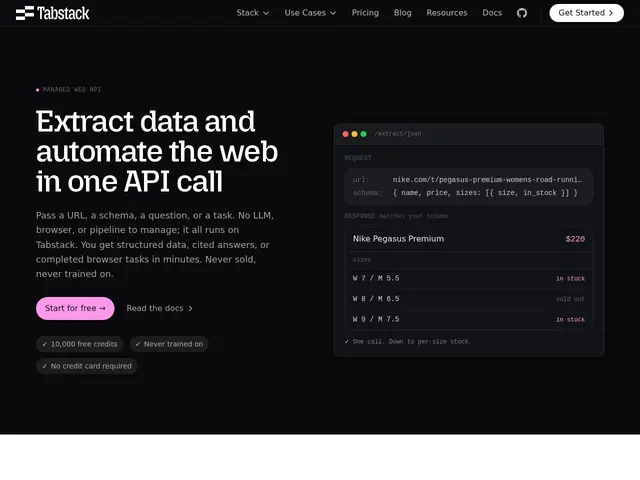
Description
Getting reliable data out of a website — or having a program click through a multi-step process on one — usually means building and maintaining your own scraper or browser automation script, which breaks every time the site changes its layout. Tabstack, built by Mozilla's experimental projects division, handles that as a managed service: you send a URL and either a schema, a question, or a task, and Tabstack runs the browser, does the extraction or automation, and hands back clean data.
Tabstack exposes four API endpoints — /extract (converts pages to JSON, Markdown, or a custom schema), /generate (transforms web data into tailored outputs), /automate (runs browser-like interactions), and /research (deploys agents to explore multiple sources and return cited answers). A Schema Source tool can auto-generate a ready-to-use JSON Schema, Zod, or Pydantic definition for any page's data. Built with ephemeral processing and a no-training-on-your-data policy, it's aimed at developers building products that depend on live web context: price monitoring, lead enrichment, market research, competitive intelligence, and internal operations agents.
💬 Our review
The short version: for developers who need reliable structured data from the web without maintaining their own scraping infrastructure, Tabstack's Mozilla backing and privacy commitments make it a credible, low-risk option to try via the free tier.
Against Firecrawl, one of the best-known tools in this space, Tabstack's differentiators are the broader endpoint set — /research for cited multi-source answers and /automate for interactive browser tasks go beyond straightforward page-to-markdown extraction — and the Mozilla affiliation, which carries real trust weight around data handling given Mozilla's privacy track record. Against Browserbase, which focuses more narrowly on raw browser infrastructure for developers to build on top of, Tabstack is a step higher up the stack with ready-made extraction and research endpoints rather than just a browser you control yourself. The honest caveat: it's a young product (its open-source CLI has only 11 GitHub stars) from Mozilla's experimental/incubation arm, which historically has both shipped lasting tools and sunset others — worth confirming it's still actively maintained before building critical infrastructure on it. At $0.35 per 1,000 credits pay-as-you-go, it's easy to test cheaply before committing to a $99+/month plan.
💰 Pricing
📊 Global score
🤖 AI-enriched data
Gratuit 10 000 crédits. Pay-as-you-go 0,35 $/1000 crédits. Team 99 $/mois (500k crédits inclus). Pro 499 $/mois (3M crédits inclus). Enterprise sur devis.
Pros
Backing Mozilla, engagement fort sur la confidentialité (pas d'entraînement sur les données clients)
4 endpoints couvrant extraction, génération, automatisation ET recherche multi-sources citée
Génération automatique de schéma (JSON Schema, Zod, Pydantic) depuis n'importe quelle page
Essai gratuit avec 10 000 crédits, pay-as-you-go accessible
Respect de robots.txt par défaut
Cons
Produit jeune, CLI open source avec seulement 11 étoiles GitHub
Issu de la branche expérimentale de Mozilla, pérennité à surveiller
Moins connu que Firecrawl dans la communauté développeurs
Coûts peuvent grimper vite en usage intensif (au-delà du tier gratuit)