Lunen
Lets a whole company build and run AI agents while giving the security team a way to see and control exactly what those agents are allowed to do — like adding guardrails and a paper trail to AI automation.
🔗 Visit Lunen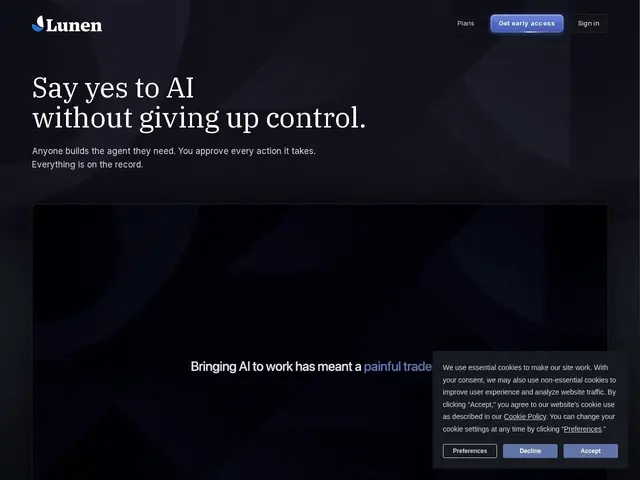
Description
Giving employees the power to build their own AI agents sounds great until the security team asks what those agents can access, whether they need approval before acting, and what happens if one misbehaves — questions that most AI agent tools were never built to answer, which is a big reason most enterprise AI pilots stall out. Lunen is built around exactly that problem: it lets non-technical staff build agents with a plain-language interface, but every tool an agent can use is governed by a policy (run automatically vs. require human approval), and every action is logged for audit.
Lunen is built by REDspace, a 25+ year enterprise platform engineering firm, and offers per-tool policy controls, unified audit logging with data-access visibility, role-based access control, and integrations with Atlassian, BigQuery, Google Workspace, HubSpot, Slack and MCP servers. The Enterprise tier adds bring-your-own-cloud (BYOC) or dedicated deployment for organizations that can't put agent activity on shared infrastructure. It's early-stage, working with design partners rather than broad general availability, with Team-tier pricing not yet public.
💬 Our review
The short version: Lunen is betting that the reason enterprise AI agent pilots fail isn't the AI, it's the missing governance layer — and building that layer, rather than another agent builder, is a defensible niche if the framing is right.
Against LangChain, which most enterprises would use to actually build agent logic, Lunen isn't a replacement — it's closer to a governance wrapper that sits around agent deployment, which is a different (and less crowded) problem than "how do I build an agent." Against Lindy or Relay.app, which target broader agent-building audiences including smaller teams, Lunen is explicitly enterprise-first, with RBAC, BYOC deployment and audit logging as core features rather than add-ons — appropriate for the compliance-heavy customers it's targeting, overkill for a small team just automating a workflow. Being built by REDspace, an established 25-year engineering firm rather than a fresh startup, is a genuine credibility signal for a governance-focused product, though Lunen itself is early-stage with undisclosed Team pricing and design-partner-stage traction. For a large organization that has already tried and stalled on AI agent pilots due to security review, it's worth a serious look; for smaller teams without a formal compliance function, it's more infrastructure than you likely need yet.
💰 Pricing
📊 Global score
🤖 AI-enriched data
Plan Team en accès anticipé (50 000 appels d'outils/mois inclus, prix non public). Plan Enterprise sur devis avec déploiement dédié/BYOC.
Pros
Contrôles de politique par outil (exécution automatique vs approbation humaine)
Journal d'audit unifié avec visibilité sur l'accès aux données
Construit par REDspace, société d'ingénierie établie depuis 25+ ans
Déploiement BYOC/dédié disponible pour l'Enterprise
Interface en langage naturel accessible aux non-techniques
Cons
Produit encore en phase de partenaires de design, pas de disponibilité générale large
Tarification du plan Team non publique
Positionnement enterprise peut être disproportionné pour une petite équipe
Aucune information de financement propre à Lunen (distinct de REDspace)