BrowserBash
Write a browser test as a plain English sentence instead of code — an AI agent reads the live page and figures out how to click through it, the way a person would.
🔗 Visit BrowserBash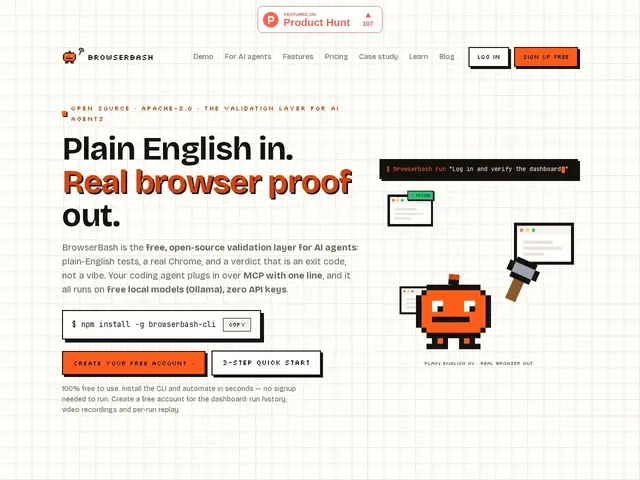
Description
Traditional browser testing tools like Selenium or Cypress require writing code that points at specific page elements, which breaks constantly whenever a website's design changes — a maintenance burden familiar to anyone who has kept a test suite running for more than a few months. BrowserBash skips the element-pointing step entirely: you write a plain-English instruction like "log in and confirm the dashboard shows the user's name," and an AI agent drives a real browser to figure out how, the way a human tester would read the page.
BrowserBash is a free, open-source (Apache-2.0) CLI built by The Testing Academy, using markdown test files with deterministic "Verify" assertions (its testmd v2 format), MCP server integration for AI coding agents, session persistence, Playwright spec import, and support for multiple LLM backends (Ollama for fully local/free runs, or Anthropic, OpenAI, OpenRouter). It works with local Chrome, raw CDP, or cloud browser providers like Browserbase, LambdaTest and BrowserStack, and includes production monitoring with webhook alerts, parallel test execution, and budget controls to cap LLM spend per run.
💬 Our review
The short version: if your test suite keeps breaking because a developer moved a button, BrowserBash's plain-English approach is a genuinely different way to write browser tests — and being free and open source removes the usual cost barrier to trying it.
Against Cypress and Playwright, the dominant selector-based frameworks, BrowserBash's core bet is that describing intent in English is more resilient to UI changes than hard-coded selectors, which is a real and provable advantage when a page's markup shifts but its purpose doesn't. Against paid AI-testing competitors like Testsigma or Leapwork, the fact that BrowserBash can run entirely on free local models via Ollama — with zero API keys or credit card needed — is a meaningful cost advantage for teams wary of per-test LLM spend. The one flag worth knowing: its GitHub repo shows zero stars despite active, recent commits and a maintained npm package, which is unusual — likely just a young, under-the-radar project rather than a red flag on its own, but it means you're an early adopter, not joining an established community. For teams frustrated with selector maintenance and comfortable with a CLI-first workflow, it's worth a serious trial, especially at zero cost; for teams needing broad community support and battle-tested maturity, Cypress or Playwright remain the safer default.
💰 Pricing
📊 Global score
🤖 AI-enriched data
100% gratuit, licence Apache-2.0, aucune carte bancaire requise. Tableau de bord cloud optionnel gratuit (15 jours de rétention).
Pros
Gratuit et open source (Apache-2.0), aucun coût même à grande échelle
Fonctionne avec des modèles locaux gratuits (Ollama), zéro clé API requise
Tests en anglais naturel, plus résistants aux changements d'interface que les sélecteurs classiques
Intégration MCP native pour les agents de code IA
Cache de replay pour ré-exécuter des tests sans re-payer un modèle IA
Cons
0 étoile GitHub malgré une activité de développement récente, projet encore sous le radar
Écosystème et communauté beaucoup plus restreints que Cypress ou Playwright
Workflow CLI-first, moins accessible qu'un outil avec interface graphique
Fiabilité de l'approche « langage naturel » encore à prouver sur des interfaces très complexes