Airtop
Automates tasks on websites that don't offer an API — logging in, clicking through forms, pulling data — the same messy manual work a human would do, but done by an AI agent instead.
🔗 Visit Airtop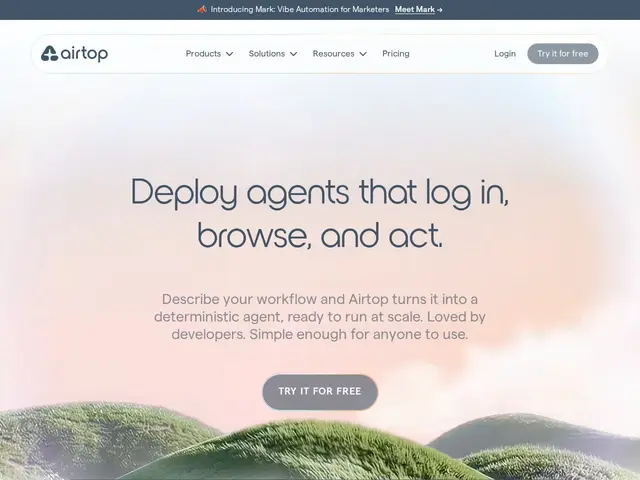
Description
Zapier and similar tools work great when the app you're connecting to has a proper API, but a huge number of business tools — old internal portals, niche vendor dashboards, sites that were never built to be automated — simply don't. Airtop's whole reason to exist is that gap: it runs real browser sessions that log in, click, fill forms, and read data exactly like a person would, so agents can automate the messy web apps that traditional automation tools can't even see.
Airtop deploys AI agents through authenticated cloud browser sessions with built-in proxies and CAPTCHA solving, a password vault for credential management, and an Agent Builder for compiling one-off automations into reusable code. It ships native integrations with Claude, Codex, n8n, Make and Zapier, plus real-time observability for monitoring agent runs. The company (a team of about 16) offers MIT-licensed open-source SDKs for Node.js and Python, and is SOC 2 Type II and HIPAA compliant, with a documented case study around invoice reconciliation automation (Cared.io).
💬 Our review
The short version: if you've hit the wall where Zapier or Make simply can't see the app you need to automate because it has no API, Airtop fills that specific gap — the tradeoff is credit-based pricing that can climb fast and a still-young open-source ecosystem.
Against Zapier, Make and n8n, Airtop isn't really a competitor so much as a complement: those tools connect apps via APIs, while Airtop automates the apps that don't offer one, using a real browser the way a human would. Against Browserbase, the closest direct comparison for AI-agent browser automation, Airtop's SOC 2/HIPAA compliance and built-in credential vault make it a more natural fit for regulated or authenticated-data workflows. The credit-based pricing (up to $502/month at the Enterprise tier) means costs scale with usage in a way flat-rate tools don't, so it's worth estimating your expected session volume before committing. The open-source SDKs having only a handful of GitHub stars so far signals the ecosystem is still small, though the core hosted product is what most users will actually rely on. For automating genuinely API-less, authenticated web apps, it's a solid, compliance-conscious choice; for anything with a real API, cheaper tools like Zapier remain the simpler answer.
💰 Pricing
📊 Global score
🤖 AI-enriched data
Gratuit (1000 crédits, 3 sessions). Starter 26 $/mois. Professional 170 $/mois. Enterprise 502 $/mois. -10% en annuel.
Pros
Automatise des applications web sans API, là où Zapier/Make ne peuvent rien faire
SDK open source (MIT) sur GitHub pour Node.js et Python
Conformité SOC 2 Type II et HIPAA
Intégrations natives avec Claude, Codex, n8n, Make, Zapier
Plan gratuit sans carte bancaire (1000 crédits)
Cons
Modèle de crédits peut devenir coûteux à volume élevé (jusqu'à 502 $/mois)
SDKs open source ont peu d'étoiles GitHub (16 et 6), adoption encore limitée
Financement de l'entreprise non divulgué
Nécessite plus de configuration qu'un outil no-code classique comme Zapier