Claw Patrol
A checkpoint that sits between your AI agents and your real systems (databases, servers, cloud accounts), reviewing every action the agent tries to take before it's allowed through.
🔗 Visit Claw Patrol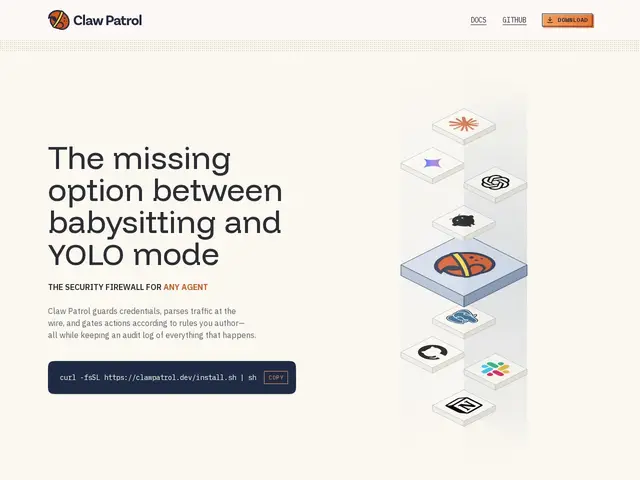
Description
If you've given an AI agent access to your company's database or cloud infrastructure, you've effectively hired a very fast, very literal new employee who can act on their own — and who currently has your admin password. Claw Patrol is like a supervisor standing next to that employee: every action gets checked against rules you write before it's allowed to happen, and anything risky (like a command that deletes data) can be blocked, or sent for a human's approval first.
Claw Patrol is an open-source (MIT-licensed) agent proxy built by the Deno team. It intercepts and parses traffic between AI agents and downstream systems at the protocol level — HTTP, SQL (Postgres, ClickHouse) and Kubernetes API calls — rather than just filtering at the LLM prompt level. Rules are written in HCL and can match on things like HTTP method or SQL verb (e.g. blocking any DROP TABLE). Ambiguous requests can be routed to an LLM judge or a human approver via Slack before executing, and the agent itself never sees the real credentials — Claw Patrol injects them at the gateway. Self-hosted deployment runs over WireGuard or Tailscale tunnels.
💬 Our review
The short version: if you're running AI agents with real production access and losing sleep over what happens the day one of them runs a destructive command, Claw Patrol gives you a policy layer to catch that — for free, since it's open source.
The comparison set here is LLM gateways (which filter prompts/responses but don't understand SQL or Kubernetes semantics), sandboxes (which isolate the agent but don't let it touch real production safely), and credential vaults like HashiCorp Boundary or Teleport (which manage access but aren't built agent-first with LLM-judge approval flows). Claw Patrol's pitch is combining credential injection, protocol-aware rule enforcement and human/LLM approval in one self-hosted piece — genuinely useful if you already run WireGuard/Tailscale infrastructure, less so if you want a managed SaaS you don't have to operate yourself. Being MIT-licensed and free removes the pricing question entirely; the real cost is engineering time to deploy, write HCL rules and keep the gateway running. Early-stage alpha software (per its own docs), so treat it as a serious building block, not a plug-and-play compliance checkbox yet.
💰 Pricing
📊 Global score
🤖 AI-enriched data
MIT license, aucun coût de licence. Self-hébergé via WireGuard ou Tailscale — le vrai coût est le temps d'ingénierie pour déployer et écrire les règles HCL.
Pros
Gratuit et open source (MIT), pas de coût de licence
Inspection au niveau protocole (HTTP, SQL, Kubernetes), pas juste au niveau du prompt LLM
Injection de credentials — l'agent ne voit jamais les vrais secrets
Approbation humaine (Slack) ou LLM-judge pour les actions ambiguës
Cons
Logiciel alpha, encore jeune — pas encore éprouvé à grande échelle
Self-hosted uniquement : demande du temps DevOps (WireGuard/Tailscale, règles HCL)
Pas de version SaaS managée pour les équipes qui ne veulent rien opérer elles-mêmes
Écosystème de règles encore à construire par chaque équipe utilisatrice