Zerve
A data-science notebook where an AI agent already knows what's in your warehouse and remembers what your team learned last quarter, instead of starting from a blank cell every time.
🔗 Visit Zerve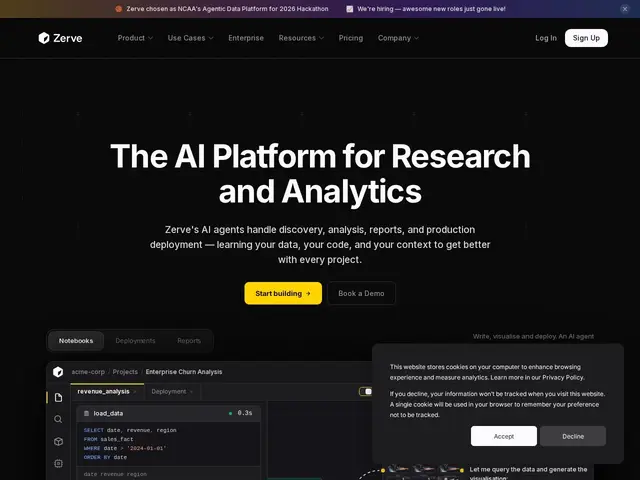
Description
A recurring pain in data science is that every new analysis starts from zero — a new notebook, a fresh look at the warehouse, no memory of what a previous analyst already figured out about that same dataset. Zerve's agentic notebooks are built to carry that context forward: the AI agent can automatically map what's in your data warehouse and keep institutional knowledge available across projects, so the next analysis doesn't repeat the last one's discovery work.
Zerve offers AI-assisted agentic notebooks, automatic data-warehouse discovery, conversational interactive reports, direct deployment of notebooks as APIs/apps/dashboards, a parallel computing fleet for large datasets, and bring-your-own-key support for OpenAI and Anthropic models, with both multi-cloud and on-premises/air-gapped deployment for sensitive data. It's backed by over $12M in funding, was selected as the NCAA's official agentic data platform for its 2026 Hackathon, and lists enterprise users including Airbus, BBC, IBM, NASA, Sky and Tesco, with the team based in Limerick, Ireland.
💬 Our review
The short version: Zerve's specific bet — an AI agent that remembers a team's accumulated data knowledge rather than starting fresh each notebook — is a real differentiator if your team does repeated analysis on the same warehouse, and the enterprise client list (Airbus, NASA, IBM) suggests it holds up under real scrutiny.
Against Hex or Deepnote (the more established AI-assisted notebook competitors), Zerve's institutional-memory angle and one-click deployment of a notebook straight to an API or dashboard are the features worth paying attention to — most notebook tools still treat each notebook as disposable once the analysis is done. The credit-based pricing (charged at LLM API cost plus 20% overhead) is transparent but means costs scale with actual AI usage rather than a flat seat price, which can be harder to budget for a team that uses it heavily. On-premises and air-gapped deployment options are a genuine advantage for regulated industries (aerospace, defense-adjacent work fits with the Airbus/NASA client list) that can't send data to a generic cloud notebook tool. Strong fit for enterprise data science teams doing recurring analysis who need on-prem options; a lighter tool like Hex is simpler if you just need occasional collaborative notebooks without the institutional-memory layer.
💰 Pricing
📊 Global score
🤖 AI-enriched data
Free : $0, 150 crédits/mois, 4 éditeurs. Pro : $18.75/utilisateur/mois (annuel). Team : $37.50/utilisateur/mois (annuel, SSO). Enterprise : sur devis (on-premise/air-gapped). Crédits facturés au coût API LLM +20%.
Pros
L'agent IA conserve la connaissance accumulée entre les analyses, pas de reprise à zéro
Déploiement direct du notebook en API/app/dashboard en un clic
Options on-premise et air-gapped pour données sensibles
Clients entreprise notables (Airbus, NASA, IBM, BBC, Tesco), $12M+ levés
Cons
Tarification aux crédits (coût API + 20%), moins prévisible qu'un prix au siège fixe
Plus complexe qu'un notebook léger comme Hex pour un usage occasionnel
Palier gratuit limité à 150 crédits/mois
Positionnement clairement entreprise, moins adapté à un usage solo léger