DecisionBox
An open-source AI agent that logs into your data warehouse overnight, writes its own SQL, double-checks every finding against the real data, and hands you a ranked list of things worth looking at — before you've asked a single question.
🔗 Visit DecisionBox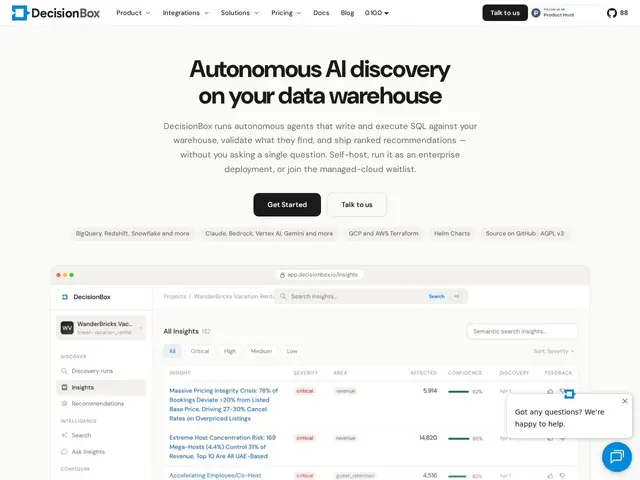
Description
Most BI tools wait for someone to ask the right question before they show anything useful — if nobody thinks to check why a metric dropped, nobody finds out. DecisionBox flips that: it's an AI agent that goes looking on its own, running dozens of SQL queries against your warehouse in a loop, forming and testing hypotheses, and only surfacing a finding once it has re-checked it against your real data.
DecisionBox is an open-source (AGPL v3) autonomous discovery agent supporting BigQuery, Redshift, Snowflake, PostgreSQL, Databricks, Oracle, SAP HANA and SQL Server, compatible with Claude, OpenAI, Gemini, Bedrock or Ollama as the underlying model, running 50-100+ queries per session with every query and reasoning step logged and visible for audit. It offers industry-specific "domain packs" (gaming, social, ecommerce) to bootstrap relevant hypotheses, self-healing SQL that recovers from errors, and cumulative learning across runs, deployable via Docker Compose on a laptop or Helm/Terraform on your own cloud.
💬 Our review
The short version: DecisionBox's core promise — an agent that finds things worth knowing in your warehouse without being asked, and proves its work by re-querying before reporting — is genuinely different from both traditional BI dashboards and generic text-to-SQL copilots, and it's free to self-host.
Against Basedash or Hex (which wait for a natural-language question and answer it), DecisionBox is proactive rather than reactive, closer in spirit to a junior analyst running exploratory SQL all night than to a chat interface — the validation step (re-querying every finding before surfacing it) is a meaningful trust mechanic that plain text-to-SQL tools don't have. Being open source under AGPL v3 with visible reasoning logs also means it can be evaluated and audited before it's given warehouse credentials, which matters for anyone nervous about handing an AI agent write-adjacent access to production data. It's still early (modest GitHub star count, no clear founding date disclosed) and self-hosting requires real infrastructure comfort (Docker/Helm/Terraform), so it's not a five-minute setup. Strong pick for a data team that wants proactive, auditable discovery and is comfortable self-hosting; skip it if you just need to answer specific questions on demand — a chat-style tool like Basedash is faster for that.
💰 Pricing
📊 Global score
🤖 AI-enriched data
Auto-hébergé gratuit (AGPL v3). Enterprise avec SSO/RBAC/gouvernance sur devis. Cloud managé en liste d'attente, prix non publié.
Pros
Proactif : explore le warehouse tout seul plutôt que d'attendre une question
Chaque résultat est re-vérifié contre les vraies données avant d'être remonté
Open source (AGPL v3), logs de raisonnement visibles et auditables
Compatible avec 8+ entrepôts et 5 fournisseurs de LLM (Claude, OpenAI, Gemini, Bedrock, Ollama)
Cons
Auto-hébergement demande de vraies compétences infra (Docker/Helm/Terraform)
Produit jeune, peu d'étoiles GitHub, pas de date de fondation communiquée
Moins rapide qu'un outil de chat pour répondre à une question précise et immédiate
Version cloud managée encore en liste d'attente