Kanwas
An open-source shared workspace where a team's context — decisions, docs, tasks — lives in one place that both people and AI coding agents can read from and write to.
🔗 Visit Kanwas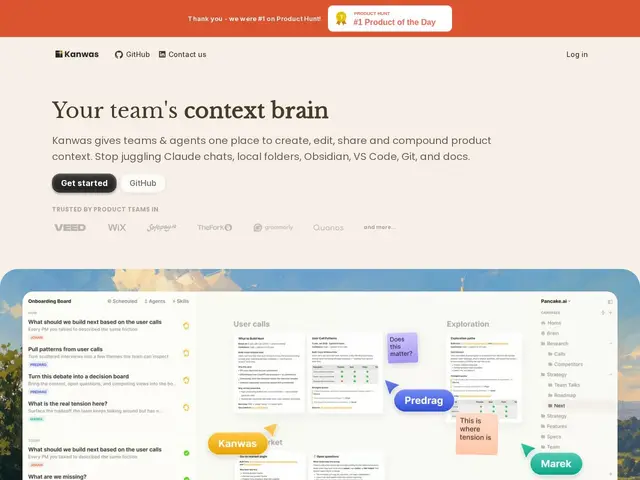
Description
A common problem for teams now working alongside AI coding agents is that context is scattered — some of it lives in Claude chat history, some in a local folder, some in Obsidian, some in Git commit messages — so neither a new teammate nor an AI agent starting a task has the full picture. Kanwas is built to be the one place that context accumulates instead, a canvas both humans and AI agents read from and write to as work happens.
Kanwas is an open-source (Apache 2.0) canvas-based workspace supporting code, docs, tasks, embeds and iframes, built around a "context graph" that compounds team knowledge over time, with an AI agent layer supporting multiple models (Claude, GPT, Gemini), real-time collaboration with granular permissions, Git-backed markdown files with full version history (no vendor lock-in), 1000+ integrations, a CLI tool, and transparent logging of what the AI agent did and why. It launched on Product Hunt in May 2026 ranking #1 for the day, has 742 GitHub stars and 105 forks, is used by teams at Veed, Wix, Softpay, TheFork, Grammarly and Quanos, and its founder credits it with helping close a €4.6M pre-seed round.
💬 Our review
The short version: Kanwas is a genuinely interesting bet on "context infrastructure for AI-agent teams" — open source, self-hostable, and Git-backed rather than proprietary — but it's early enough (launched May 2026) that the ecosystem and workflows around it are still forming.
Against Notion (which is adding its own AI agents) or a plain Obsidian + Git setup, Kanwas's specific bet is treating AI agents as first-class citizens of the workspace rather than a bolt-on feature, plus avoiding vendor lock-in by storing everything as Git-backed markdown you can pull out at any time — a meaningfully different promise than Notion's proprietary database format. The multi-model AI support (Claude, GPT, Gemini) rather than being tied to one vendor is also a sensible hedge given how fast that space moves. The risk with any month-old open-source tool is momentum: 742 GitHub stars and a strong Product Hunt launch are encouraging signals, but it's not yet the kind of multi-year track record Notion or Confluence have. Worth adopting now if you want Git-native, agent-first team knowledge and are comfortable with an early tool; stick with Notion if you need a mature, battle-tested product today.
💰 Pricing
📊 Global score
🤖 AI-enriched data
Gratuit et open source (Apache 2.0), auto-hébergeable sans frais. Version hébergée : grille tarifaire complète non publiée au lancement.
Pros
Open source (Apache 2.0), auto-hébergeable gratuitement, fichiers Git-backed sans vendor lock-in
Agents IA multi-modèles (Claude, GPT, Gemini) natifs dans l'espace de travail
#1 Product Hunt au lancement (mai 2026), 742 étoiles GitHub
Utilisé par des équipes reconnues (Veed, Wix, Grammarly, TheFork)
Cons
Produit très jeune (lancé mai 2026), écosystème encore en formation
Grille tarifaire de la version hébergée pas entièrement publique
Moins mature que Notion ou Confluence sur la robustesse en production
La valeur dépend fortement d'un usage déjà avancé des agents IA en équipe