Page Agent
A free tool that lets an AI type a plain-English instruction like "click the checkout button" and have it actually happen on a webpage — by reading the page's real structure instead of taking a screenshot and guessing where things are.
🔗 Visit Page Agent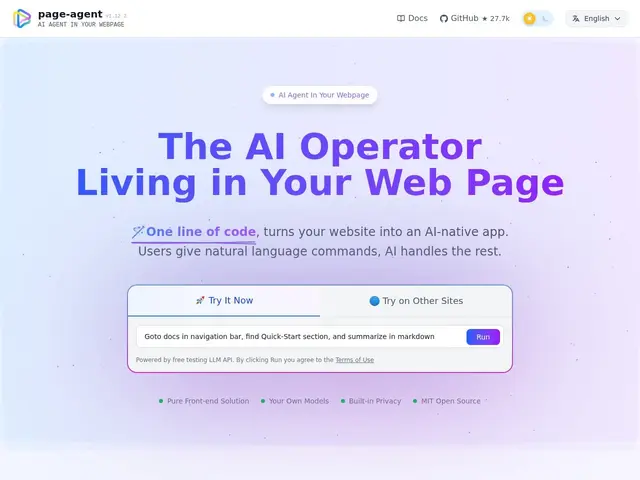
Description
Most tools that let an AI control a web browser work by taking a screenshot and having the AI guess where to click based on the image — slow, and it breaks easily if the layout shifts slightly. Page Agent takes a more precise approach: it reads the actual structure of the webpage (the DOM) and lets the AI issue natural-language commands directly against real page elements, without needing a screenshot, a browser extension, Python, or a full headless browser setup.
Page Agent is a free, open-source (MIT license, ~27,700 GitHub stars) JavaScript/TypeScript tool built by Alibaba for in-page GUI automation, controlling web interfaces through natural language commands using text-based DOM manipulation rather than visual/screenshot methods. It's compatible with mainstream and locally-deployed LLMs, includes an optional Chrome extension for automating across multiple pages/tabs, supports MCP Server integration (in beta), and can also be used to enhance web accessibility by letting users control interfaces through natural language commands.
💬 Our review
The short version: if you're automating web interactions and tired of screenshot-based agents breaking every time a page's visual layout shifts slightly, Page Agent's text-based DOM approach is a more robust technical foundation for the same goal.
Coming from Alibaba, a company that runs some of the largest e-commerce and web platforms in the world, this isn't a hobby project — it likely reflects real internal experience automating complex web UIs at scale, which shows in the design choice to skip screenshots entirely. The tradeoff against vision-based agents (which can technically handle any visual interface, including ones without accessible DOM structure) is that Page Agent depends on the page having a reasonably well-structured DOM to work with; a poorly-built or heavily obfuscated web app could still trip it up. For automating well-structured modern web applications, it's a faster, more reliable approach than screenshot-guessing; for automating legacy or intentionally obfuscated interfaces, a vision-based fallback tool might still be needed.
💰 Pricing
📊 Global score
🤖 AI-enriched data
Entièrement gratuit et open source (licence MIT).
Pros
Gratuit, open source, développé par Alibaba (expérience à grande échelle)
Manipulation DOM textuelle, plus rapide et fiable que la capture d'écran
Pas besoin de navigateur headless complet ni de Python
Compatible avec des LLM déployés localement
Cons
Dépend d'une structure DOM raisonnablement propre — moins fiable sur des interfaces obfusquées
Support MCP encore en bêta
Documentation principalement en anglais/chinois selon l'origine du projet
Marché déjà occupé par plusieurs outils d'automatisation web pour agents