codebase-memory-mcp
A free tool that builds a detailed, searchable map of your entire codebase once, then answers questions about it almost instantly — so an AI coding assistant doesn't have to re-scan your whole project every single time it needs context.
🔗 Visit codebase-memory-mcp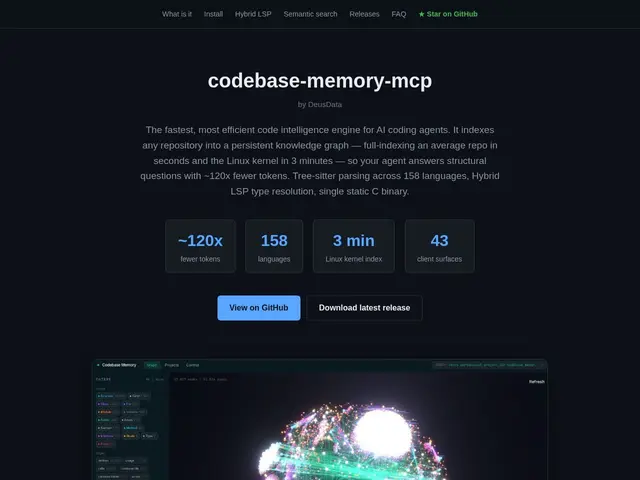
Description
AI coding assistants often waste time and tokens re-exploring a codebase file by file every time they need to understand how something connects to something else. codebase-memory-mcp builds a persistent knowledge graph of your entire codebase up front — functions, calls, types, relationships — and answers structural questions against that graph in milliseconds instead of re-reading files from scratch.
codebase-memory-mcp is a free, open-source (MIT license, ~35,000 GitHub stars) Rust-based MCP server supporting 158 programming languages via a vendored tree-sitter parser, offering sub-millisecond semantic queries, a zero-dependency single static binary, 15 MCP tools including semantic search and call-graph tracing, a built-in 3D graph visualization UI, hybrid LSP-based semantic type resolution for 12 languages, and automatic integration with 43 different AI coding agents including Claude Code, Cursor, VS Code, Aider and Gemini CLI. It's explicitly designed as a structural-analysis backend for AI agents rather than embedding its own LLM.
💬 Our review
The short version: if you want AI coding assistants to understand your codebase's structure instantly instead of re-scanning it every time, codebase-memory-mcp's persistent knowledge graph approach with 158-language support is one of the more technically ambitious free options available.
The closest comparison on this catalog is Code-Review-Graph, another code-intelligence MCP tool inserted the same day — the two take genuinely different technical approaches: Code-Review-Graph emphasizes blast-radius analysis specifically for code review workflows, while codebase-memory-mcp emphasizes raw indexing scale and speed (158 languages, sub-millisecond queries, 43 agent integrations) as a general-purpose structural backend. Its significantly higher star count and language coverage suggest broader current adoption, but a genuinely useful comparison requires testing both against your specific codebase and agent stack rather than picking by star count alone — different projects will fit different workflows. Both are free, so trying both costs only setup time.
💰 Pricing
📊 Global score
🤖 AI-enriched data
Entièrement gratuit et open source (licence MIT).
Pros
Gratuit, open source, très large adoption (35 000+ étoiles)
Support de 158 langages via tree-sitter
Requêtes sémantiques sous la milliseconde, binaire unique sans dépendance
Intégration automatique avec 43 agents de code IA différents
Cons
Chevauchement fonctionnel avec Code-Review-Graph, à comparer selon son propre besoin
Configuration technique nécessaire (MCP)
Résolution sémantique via LSP limitée à 12 langages (vs 158 pour le parsing brut)
Peu de retours d'expérience en production à très grande échelle disponibles publiquement