Strix
A free tool that automatically tries to hack into your own web application to find security holes before a real attacker does, then proves each vulnerability actually works instead of just guessing at it.
🔗 Visit Strix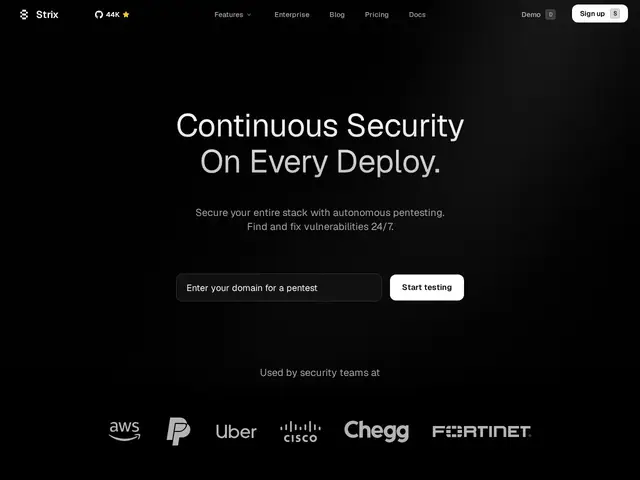
Description
Manual penetration testing — hiring a security expert to try to break into your app — is thorough but expensive and slow, so a lot of smaller teams skip it entirely and ship with unknown vulnerabilities. Strix automates the core of that process with AI agents that scan your application, attempt real exploits, and confirm which vulnerabilities are genuinely exploitable rather than just flagging theoretical issues, so your team can trust the results and fix what actually matters.
Strix is a free, open-source (Apache 2.0, ~44,000 GitHub stars) AI-powered penetration testing tool using multi-agent orchestration across reconnaissance, exploitation and proof-of-concept validation, with comprehensive coverage of the OWASP Top 10 vulnerability categories, an HTTP interception proxy and browser exploitation capabilities, a developer-focused CLI with remediation guidance, automated patch generation, compliance reporting, and diff-scoped testing that can run against just the code changed in a pull request. It supports multiple LLM providers and integrates with GitHub Actions and other CI/CD pipelines.
💬 Our review
The short version: if your team can't afford regular professional penetration testing but wants more than a static analysis linter, Strix's AI-agent-driven, exploit-validated approach is a genuinely more rigorous free option than most open-source security scanners.
The proof-of-concept validation is the key differentiator — most free security scanners flag potential issues based on patterns, generating a lot of noise that developers learn to ignore; Strix's agents actually attempt the exploit, which means fewer false positives and more actionable findings. At 44,000 GitHub stars, it's among the more validated tools in this catalog's security section, suggesting real trust from the security community. The obvious caveat with any automated pentesting tool: it augments but doesn't replace a human security review for anything genuinely high-stakes (handling payments, health data, critical infrastructure) — automated tools miss business-logic vulnerabilities that require human judgment to spot. For CI/CD-integrated continuous security testing on every PR, it's an excellent free addition; for a pre-launch audit of a critical system, still budget for professional human pentesting too.
💰 Pricing
📊 Global score
🤖 AI-enriched data
Entièrement gratuit et open source (licence Apache 2.0).
Pros
Gratuit, open source, très large adoption (44 000+ étoiles)
Validation par preuve de concept réelle, pas juste des alertes théoriques
Couverture complète OWASP Top 10
Intégration CI/CD native, tests scoping sur les diffs de PR
Cons
Ne remplace pas un audit de sécurité humain pour les systèmes vraiment critiques
Peut manquer des vulnérabilités de logique métier nécessitant un jugement humain
Nécessite une configuration technique pour l'intégration CI/CD
Dépend de la qualité du LLM fourni en backend