Code-Review-Graph
A free tool that builds a map of how all the files in your codebase connect to each other, so an AI coding assistant only reads the parts of your code that are actually relevant instead of the entire repository every time.
🔗 Visit Code-Review-Graph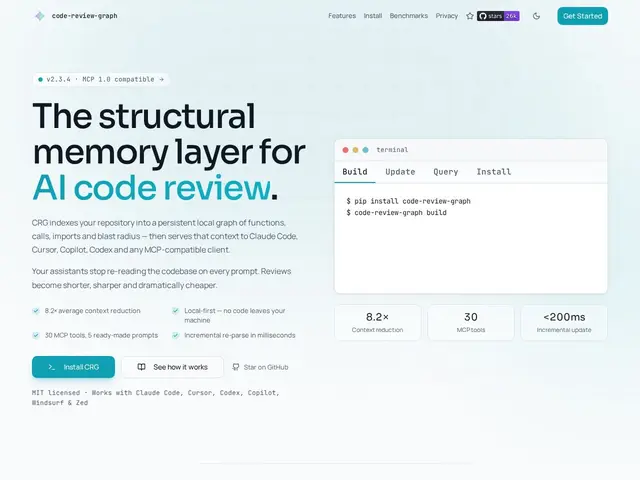
Description
When an AI coding assistant reviews or edits code in a large repository, feeding it the whole codebase every time is slow and expensive — most of that context isn't relevant to the specific change being made. Code-Review-Graph solves this by building a persistent map of how functions, files and modules relate to each other, so an AI tool can ask "what does this change actually affect?" and get back just the relevant pieces instead of everything.
Code-Review-Graph is a free, open-source (MIT license, ~26,000 GitHub stars) local-first code intelligence graph exposing 30 MCP tools for AI coding assistants, with blast-radius analysis for code changes, incremental parsing updates under 2 seconds, support for 25+ programming languages (including Jupyter notebooks and PHP/Laravel with Blade templates), a GitHub Action for automated risk scoring, and SQLite-based local storage with zero telemetry. The project reports an 82x median token reduction per AI query and supports multi-repo registries for larger organizations.
💬 Our review
The short version: if your AI coding assistant is burning through context (and money) re-reading your entire repo for every small change, Code-Review-Graph's targeted context retrieval is built specifically to fix that.
The 82x median token reduction claim is striking, and even a fraction of that in practice would meaningfully cut AI coding costs on a large codebase — the local-first, zero-telemetry design is also a genuine plus for teams wary of sending proprietary code to third-party services. As a very new project (created February 2026) that's grown to 26,000+ stars extremely fast, it's worth watching how it holds up under real-world use across the 25+ languages it claims to support; broad language support is often uneven in practice for young projects. For a team already using MCP-compatible AI tools on a sizeable codebase, it's a low-risk try since it's free and local; for someone on a small personal project, the setup overhead probably isn't worth it yet.
💰 Pricing
📊 Global score
🤖 AI-enriched data
Entièrement gratuit et open source (licence MIT), fonctionne en local.
Pros
Gratuit, open source, 100% local (zéro télémétrie)
Réduction de tokens revendiquée jusqu'à 82x en médiane
Support de 25+ langages, mises à jour incrémentales sous 2 secondes
30 outils MCP exposés, intégration GitHub Action pour le scoring de risque
Cons
Projet très jeune (créé février 2026), croissance d'étoiles rapide à prendre avec prudence
Support de 25+ langages potentiellement inégal en pratique pour un projet si récent
Nécessite une intégration technique (MCP, CLI), pas un outil clé en main
Peu de retours d'expérience en production à grande échelle disponibles