Upsolve AI
Instead of a non-technical employee waiting days for a data analyst to answer a question like "which region's sales dropped last quarter," Upsolve AI lets them ask that question in plain English and get a verified, sourced answer directly — while giving t
🔗 Visit Upsolve AI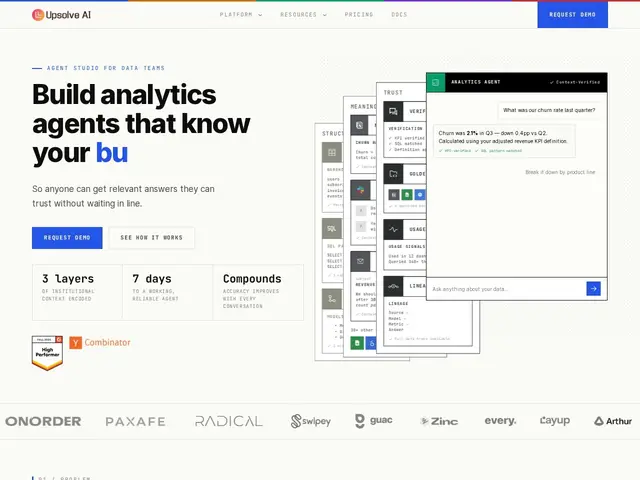
Description
In most companies, getting a specific data answer means filing a request and waiting for a data analyst to write a query — a bottleneck that grows as more people across the company want data-driven answers. Chat-with-your-data tools promise to remove that wait, but many are prone to confidently making up numbers. Upsolve AI's pitch is doing this properly: fast AND grounded in your actual data.
Upsolve AI is a platform for building and deploying "data agents" that answer natural-language questions about a company's data, built around a three-layer context architecture (Structure, Meaning, Trust) specifically designed to reduce hallucinated answers. It connects to 30+ SQL databases (Snowflake, BigQuery, Redshift, Databricks, Postgres, MySQL, and more), can import an existing dbt project, and deploys across Slack, Teams, Claude, ChatGPT, Cursor, or embedded via SDK. Agent Studio gives data teams observability into every question asked, full conversation tracing, and a built-in evaluation agent that grades answers for hallucination before they reach end users. It's a Y Combinator (W24) company founded by a team that built HyperAuto at Palantir.
💬 Our review
The short version: if your data team is drowning in one-off data requests from non-technical stakeholders, Upsolve AI's governance-first approach to a chat-with-your-data agent is a genuine differentiator against tools that prioritize speed over accuracy — the built-in hallucination grading is the feature that actually matters here.
Against general BI copilots like Findly or established players adding AI chat (Tableau, Looker's Gemini-powered features), Upsolve AI leans harder into governance and auditability, which matters more at companies where a wrong number in a board deck is a real risk, not just an inconvenience. Pricing scales steeply from Pro ($500/month, ~200 questions) to Team ($2,000/month, ~1,000 questions) — this is enterprise-tier pricing, not a tool for a five-person startup testing the waters, and the free tier's one-time (not recurring) credits make it hard to evaluate long-term fit without paying. Worth it for a data team at a company large enough that ungoverned AI answers pose real reputational risk; overkill for a small team that just wants quick dashboards.
💰 Pricing
📊 Global score
🤖 AI-enriched data
Free : 2 000 crédits ponctuels (~200 questions). Pro : $500/mois (2 000 crédits/mois). Team : $2 000/mois (10 000 crédits/mois). Enterprise : sur devis, on-premise/VPC possible.
Pros
Architecture à 3 couches pensée pour réduire les hallucinations
30+ connecteurs SQL, compatible dbt
Déploiement multi-surface (Slack, Teams, Claude, ChatGPT, SDK)
Agent d'évaluation intégré qui note les réponses avant qu'elles n'atteignent l'utilisateur
Cons
Tarification enterprise ($500-2000/mois), pas pour une petite équipe
Crédits gratuits à usage unique, pas récurrents
Complexité de mise en place plus élevée qu'un outil BI généraliste