Findly
Instead of learning SQL or waiting for someone on the data team to build a chart, Findly lets a supply chain manager or trader type a plain-English question about their data — "how did shipping costs change last month" — and get back an answer, a chart, a
🔗 Visit Findly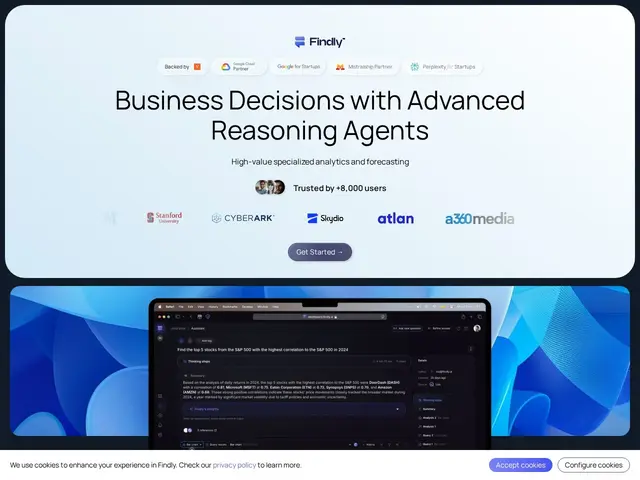
Description
Reading raw business data usually requires either SQL knowledge or asking a data-savvy colleague to build a report, both of which slow down decisions that need to happen quickly. Findly tries to remove that dependency by combining a large language model with a semantic layer that understands the structure of a company's data, so a question in plain English produces a real, grounded answer.
Findly is a conversational business intelligence platform aimed particularly at trading teams (commodity and energy markets), supply chain managers, consulting firms, and e-commerce/retail businesses that need forecasting alongside standard reporting. Beyond querying, it offers price forecasting and risk management alerts, connects to Google Analytics, BigQuery, Google Search Console, Slack, Stripe, and HubSpot among others, and generates reports with scheduled email delivery. It's SOC 2 Type II and ISO 27001 compliant, with a free tier for up to 3 users and a currently discounted Standard plan.
💬 Our review
The short version: Findly is a reasonable pick for a smaller team — especially in trading, supply chain, or e-commerce — that wants natural-language answers and forecasting without the SQL learning curve or a dedicated analyst, and the free 3-user tier makes it low-risk to try.
It sits in similar territory to Upsolve AI, both offering natural-language querying over business data, but Findly leans more toward out-of-the-box forecasting and vertical-specific features (commodity price forecasting, supply chain risk alerts) while Upsolve leans harder into governance and hallucination-checking for larger, more risk-sensitive organizations. At $149/month (discounted from $497) for up to 10 users, Findly is meaningfully cheaper for a mid-size team than Upsolve's $500+/month tiers — worth checking whether that discount is time-limited before committing budget around it. If your priority is forecasting and quick reporting over heavy data governance, Findly's pricing and vertical focus make it the more accessible option.
💰 Pricing
📊 Global score
🤖 AI-enriched data
Free : $0, jusqu'à 3 utilisateurs. Standard : $149/mois facturé annuellement (prix normal $497/mois, remise de lancement 70%), jusqu'à 10 utilisateurs. Enterprise : sur devis, utilisateurs illimités.
Pros
Requêtes en langage naturel sans SQL
Prévisions de prix et alertes de gestion de risque intégrées
Plan gratuit jusqu'à 3 utilisateurs
Standard bien moins cher qu'Upsolve AI pour une équipe de taille similaire
Cons
Remise de lancement à 70% probablement temporaire — vérifier le prix réel
Moins de garde-fous anti-hallucination détaillés qu'Upsolve AI
Positionnement fort sur certaines verticales (trading), moins généraliste