Opslane
When an AI coding agent opens a pull request, someone still has to check it actually works — Opslane automates that check by running the change in a real Chromium browser, taking screenshots and video of the result, and blocking the merge if something's v
🔗 Visit Opslane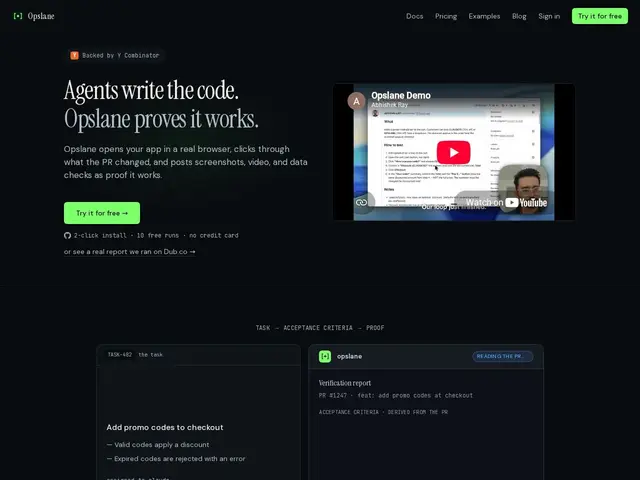
Description
AI coding agents can now open pull requests faster than any human reviewer can manually click through and verify them, which creates a new bottleneck: someone still has to confirm the change actually works in a real browser, not just that the code compiles or passes a narrow unit test. Opslane automates that verification step directly.
Opslane runs each pull request in a real Chromium browser inside a fresh, disposable environment, captures screenshots and video of the resulting app state, and checks data/assertions to confirm the change behaves as intended — then blocks the merge if a check fails. It's stack-agnostic, working with React, Next.js, Vue, Rails, Django, and others, and is aimed specifically at teams whose pull request volume has grown because of AI coding agents, replacing the need to hand-write and maintain a full Playwright or Cypress test suite for every change. Pricing starts free (10 verification runs), then $20/developer/month for 50 runs (additional runs at $0.50 each), with a custom Enterprise tier offering SSO, SAML, and SOC 2 Type II.
💬 Our review
The short version: if your team has adopted AI coding agents and pull request volume has outpaced your team's ability to manually verify each one works, Opslane's automated real-browser verification is a genuinely useful safety net — it catches visibly broken changes before merge without requiring you to hand-write test scripts.
It sits between traditional test frameworks like Playwright and Cypress (which require writing and maintaining test code yourself) and AI code review tools like CodeRabbit or Greptile (which review the code statically but don't actually run it in a browser to confirm behavior). Opslane's pitch is that it does the running-and-proving step those tools skip. At $20/developer/month plus per-run overage, cost scales with team size and PR volume, which is fair given AI agents can generate far more PRs than a human team alone — but it's an added line item on top of whatever CI you already run, worth it specifically if "does this actually work" has become a real bottleneck, not a nice-to-have for a low-PR-volume team.
💰 Pricing
📊 Global score
🤖 AI-enriched data
Free : 10 runs de vérification. Developer : $20/développeur/mois (50 runs, puis $0.50/run). Enterprise : sur devis (SSO, SAML, SOC 2 Type II).
Pros
Exécution des PR dans un vrai navigateur Chromium, pas juste une analyse statique
Capture automatique de screenshots et vidéos
Bloque le merge si une vérification échoue
Agnostique côté stack (React, Next.js, Vue, Rails, Django)
Cons
Coût qui grimpe avec le volume de PR (par-dessus le CI existant)
Pertinent surtout si le volume de PR généré par IA est déjà un problème
Positionnement du produit qui semble avoir évolué (attention à vérifier l'offre actuelle)