Refuse
A free, open-source tool that sits in front of npm, pip, cargo, and 15 other package managers and blocks you — or your AI coding agent — from installing a package with a known security vulnerability, before it ever touches your project.
🔗 Visit Refuse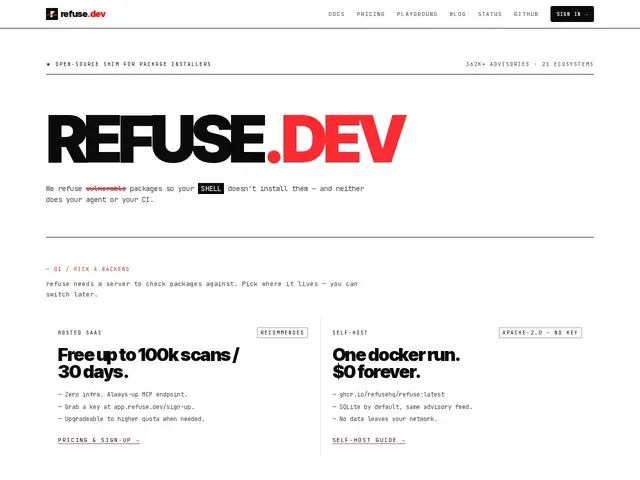
Description
Installing an open-source package usually means trusting that nobody checked whether it or one of its dependencies has a known security hole, and that risk has gotten worse now that AI coding agents can install packages on their own without a human double-checking each one first. Refuse works like a security guard standing at the door of your package manager: before npm install, pip install, or any of 16 other install commands actually run, it checks the exact package and version against a huge, current database of known vulnerabilities, and simply refuses the install — telling you which safe version to use instead — if there's a match.
Refuse is a free, open-source (Apache-2.0) pre-install shim wrapping 18 package managers (npm, pnpm, yarn, bun, npx, pip, pip3, uv, poetry, pipenv, pdm, pipx, cargo, gem, bundle, go, composer, dotnet). It intercepts install commands and checks the target package/version against 362,000+ security advisories across 21 ecosystems, blocking installs that match a known vulnerability and suggesting a safe alternative version. It was built specifically in response to a documented surge in 2026 supply-chain attacks targeting AI coding agents that auto-install dependencies without review. It's self-hostable as a single Docker container with your own CVE backend, and collects no telemetry.
💬 Our review
The short version: Refuse is close to a no-brainer install for any developer or team letting an AI coding agent run package-install commands unsupervised — it's free, open source, and closes a very real, currently-being-exploited gap.
The specific threat model here — an autonomous coding agent installing a compromised package without a human in the loop to sanity-check it — is a genuinely new risk that most existing dependency-scanning tools (which typically audit after installation, on a schedule) don't address at the moment it matters most: before the malicious code ever runs on your machine. Supporting 18 package managers in one shim is broad enough to cover most real-world polyglot projects rather than locking you into a single ecosystem. Being free, open-source, self-hostable, and telemetry-free removes essentially every reason not to adopt it if you're running any agent-driven or CI-driven install pipeline. The only real limitation is coverage: like any vulnerability database, it can only block what's already been disclosed and indexed, so it reduces risk meaningfully without being a complete guarantee against zero-day supply-chain attacks.
💰 Pricing
📊 Global score
🤖 AI-enriched data
Entièrement gratuit sous licence Apache-2.0, auto-hébergeable (conteneur Docker unique), zéro télémétrie.
Pros
Bloque AVANT l'installation, pas après coup comme la plupart des scanners
Couvre 18 gestionnaires de paquets en un seul outil
362 000+ avis de sécurité sur 21 écosystèmes
Gratuit, open source, auto-hébergeable, zéro télémétrie
Cons
Ne protège que contre les vulnérabilités déjà connues et indexées, pas les zero-day
Nécessite d'installer et maintenir soi-même le shim sur chaque environnement
Pas de service managé officiel si l'auto-hébergement pose problème