Graphify
A tool that maps your codebase into a graph of how everything connects, so AI coding assistants like Claude Code or Cursor can actually understand your project's structure instead of guessing from scattered file snippets.
🔗 Visit Graphify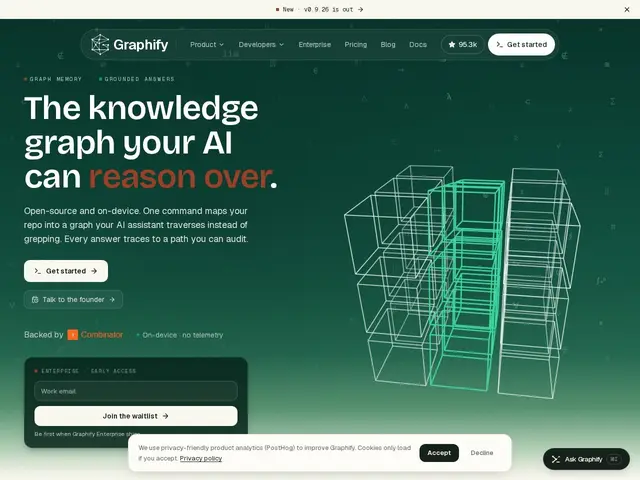
Description
AI coding assistants are often only as good as their understanding of your codebase, and most tools give them that understanding through vector search over chunks of text — which can miss how files, functions, and modules actually relate to each other. Graphify takes a different approach: run a single command inside your AI coding assistant, and it maps your code, docs, and even PDFs into an interactive knowledge graph, so the assistant can navigate real relationships instead of guessing from fragments.
Graphify is an open-source (Apache 2.0) tool that converts codebases into queryable knowledge graphs for AI coding assistants like Claude Code, Cursor, and Gemini CLI. It uses local, deterministic AST (abstract syntax tree) parsing — not embeddings or external APIs — to build the graph, which means the core indexing runs without sending your code to a third-party service. It supports 40+ languages via tree-sitter and integrates as an MCP server for direct use inside supported AI assistants. It's free and open source, with the company behind it also developing a separate enterprise version with a waitlist.
💬 Our review
The short version: if your AI coding assistant keeps missing how parts of your codebase connect to each other, Graphify gives it a structural map to navigate instead of relying purely on text-similarity search — and the core tool is free and open source.
Its differentiator against retrieval approaches like Sourcegraph Cody or Continue.dev is the underlying technique: local AST parsing builds a deterministic graph of actual code relationships, rather than vector embeddings that approximate similarity — which can mean more precise citations and fewer "almost right" answers from the assistant. Running locally without external APIs for the core indexing is also a real privacy plus for teams wary of sending code to a third party. The tradeoff is that AST-based graphs, while precise about structure, may capture semantic intent less flexibly than embedding-based search in some cases, and as with any newer dev-tool project, expect some rough edges compared to a mature, well-funded competitor. Good fit for teams using Claude Code, Cursor, or Gemini CLI on large or complex codebases who want more reliable context; less necessary for small projects where a simple embedding search already works fine.
📊 Global score
🤖 AI-enriched data
Open source (Apache 2.0), gratuit ; une version enterprise séparée est en développement avec liste d'attente
Pros
Parsing AST local et déterministe, pas d'embeddings ni d'API externe pour l'indexation
Supporte 40+ langages via tree-sitter
S'intègre comme serveur MCP directement dans les assistants IA compatibles
Open source (Apache 2.0), gratuit
Cons
Approche AST potentiellement moins flexible qu'une recherche par embeddings sur l'intention sémantique
Projet plus jeune que des concurrents établis comme Sourcegraph
Version enterprise encore en liste d'attente, roadmap commerciale pas totalement claire
Bénéfice principal surtout visible sur des bases de code volumineuses/complexes