Dyad
A tool that turns a plain-English description of an app into working code — but instead of running in someone else's cloud, it runs on your own computer, so your project and your AI usage stay under your control.
🔗 Visit Dyad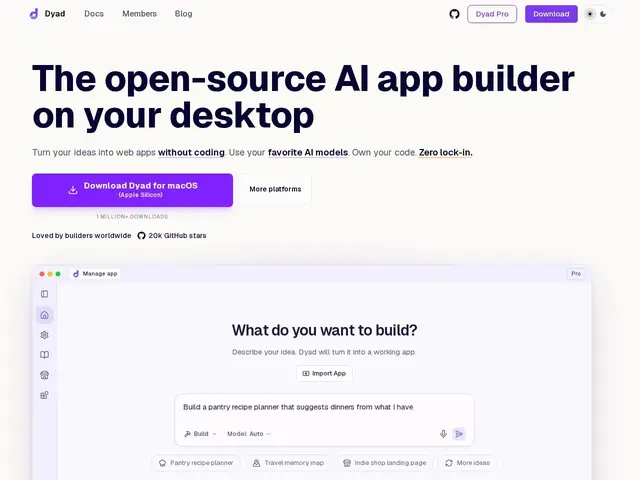
Description
AI app builders like Lovable, v0, or Bolt let you describe an app and get working code back, which is genuinely useful — but they're all cloud services: your project lives on their servers, and you're locked into their pricing and infrastructure. Dyad does the same core thing (describe an app, get a full-stack build) but runs as a desktop app on your own machine, so the code stays yours from the start, exportable at any time.
Dyad is an open-source, locally-run AI app builder for turning natural-language descriptions into full-stack web applications, aimed at both non-technical builders and developers who want a faster starting point without giving up control of their code or data. Because it runs locally, you can plug in your own AI API keys (rather than being locked into one provider), and every project is exportable as plain code with no vendor lock-in. It's free to use with a community-supported desktop builder; Pro at $20/month adds exclusive AI modes, 200 monthly credits, and academy access, while Max at $79/month scales to 900 credits and priority support.
💬 Our review
The short version: if you like the idea of AI app builders like Lovable or Bolt but don't want your project trapped in someone else's cloud platform, Dyad gives you the same describe-to-app workflow running locally, with your code exportable at any point.
Its real differentiator against Lovable, v0, and Bolt is architecture: those are all cloud-hosted, credit-metered platforms where the project effectively lives on their infrastructure; Dyad runs on your machine and lets you bring your own API keys, so you're not paying a markup on top of the AI provider's own pricing and you're never locked out of your own project. That's a meaningful advantage for developers who want to prototype fast without a long-term dependency. The tradeoff is that a desktop, BYO-key tool asks more of the user upfront — you need to manage your own API keys and understand a bit more about what's happening under the hood than with a fully managed cloud builder, and the free tier's community support won't match the polish of a well-funded SaaS competitor's onboarding. Good fit for developers and technical builders who value ownership and portability; a fully managed cloud builder like Lovable may still feel smoother for someone who just wants zero setup.
📊 Global score
🤖 AI-enriched data
Gratuit (constructeur desktop complet, support communautaire) ; Pro 20$/mois (modes IA exclusifs, 200 crédits/mois, accès academy) ; Max 79$/mois (900 crédits/mois, support prioritaire)
Pros
Tourne en local, code exportable à tout moment, pas de lock-in cloud
Compatible avec vos propres clés API IA (pas de markup imposé)
Open source, transparent sur ce qui se passe sous le capot
Palier gratuit complet avec constructeur desktop entier
Cons
Nécessite de gérer soi-même ses clés API — plus de friction initiale qu'un outil cloud tout-en-un
Support communautaire sur le gratuit, moins poli qu'un onboarding SaaS financé
Moins simple d'accès pour un non-technicien complet comparé à Lovable
Crédits limités même sur les paliers payants (200 à 900/mois)