Context.dev
A service that turns messy web pages into clean, structured data your app or AI agent can actually use — so you don't have to build and maintain your own web-scraping infrastructure.
🔗 Visit Context.dev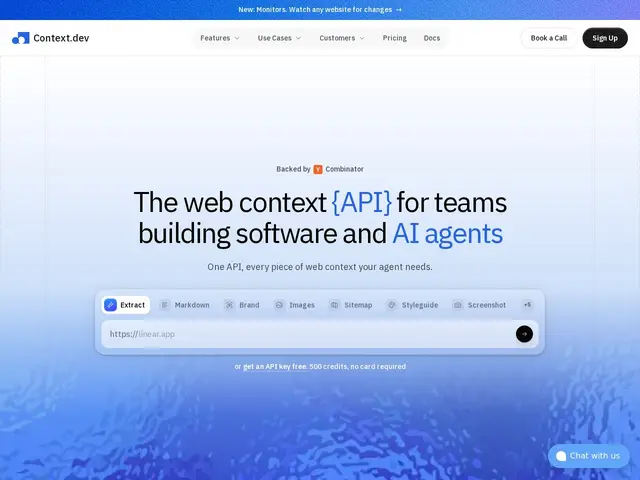
Description
If you've ever wanted your app or an AI agent to "read" a website — pull out prices, articles, or company info — you quickly run into the messy reality of the web: every page is built differently, blocks bots, or buries the data you want inside layers of ads and scripts. Building and maintaining code to handle all of that reliably is a project in itself. Context.dev sells that problem away: you send it a URL, and it hands back clean, structured data, already parsed and ready to use.
Context.dev is a web context API platform aimed at developers and AI agents that need reliable access to structured web data — scraping, document parsing, crawling, and structured extraction — without standing up their own scraping infrastructure (proxies, headless browsers, anti-bot handling). It ships SDKs in five languages plus an MCP server, so AI agents built on frameworks that speak MCP can call it directly as a tool. Pricing runs on a credit system: a free tier (500 credits), then Developer at $25/month (10K credits), Pro at $149/month (200K credits), Scale at $499/month (1M credits), and custom Enterprise plans, with credits consumed per successfully scraped page.
💬 Our review
The short version: if your product or AI agent needs to pull structured data from arbitrary websites and you don't want to own the headache of proxies, headless browsers, and anti-bot workarounds, Context.dev turns that into an API call and a monthly bill.
Its angle against general-purpose scraping frameworks (Scrapy, Playwright you self-host) is that it removes the infrastructure burden entirely — you pay per successfully scraped page instead of per server-hour, and you only pay when it actually works. Against other scraping-as-a-service competitors like Firecrawl or Apify, the MCP server support is a real differentiator right now, since it plugs straight into AI agent frameworks without custom glue code. The catch is the credit model: heavy, high-volume scraping can get expensive fast compared to running your own scraper at scale, and like any third-party scraping API, you're dependent on their infrastructure staying ahead of sites' anti-bot defenses. Good fit for teams building AI agents or data pipelines that need web data now, not for a one-off scraping script you could write in an afternoon.
📊 Global score
🤖 AI-enriched data
Gratuit (500 crédits) ; Developer 25$/mois (10K crédits) ; Pro 149$/mois (200K crédits) ; Scale 499$/mois (1M crédits) ; Enterprise sur devis. Crédits consommés par page scrapée avec succès
Pros
SDKs dans 5 langages + serveur MCP natif pour agents IA
Aucune infrastructure de scraping à gérer soi-même (proxies, navigateurs headless, anti-bot)
Paiement uniquement sur les pages scrapées avec succès
Certifié SOC 2 Type I, backé par Y Combinator
Cons
Modèle à crédits qui peut coûter cher en usage intensif comparé à une infra auto-hébergée à grande échelle
Dépendance à leur capacité à suivre les défenses anti-bot des sites cibles
Palier Pro à 149$/mois pour seulement 200K crédits, coûteux pour du gros volume
Pas de plan gratuit persistant pour un usage en production