Daemons (Charlie Labs)
Keeps the small, tedious engineering chores moving in the background — nudging stale pull requests, triaging bug reports, updating docs — like having a diligent junior teammate who never sleeps and never needs to be asked twice.
🔗 Visit Daemons (Charlie Labs)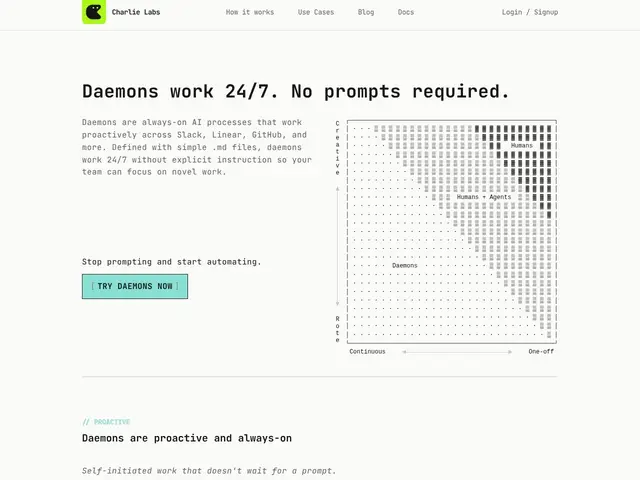
Description
AI coding tools are great at producing new code fast, but someone still has to keep the resulting pile of pull requests, issues, and outdated docs from turning into a mess. That's the gap Charlie Labs is targeting: not writing more code, but keeping the code and process that already exists healthy.
Charlie Labs' product, called Daemons, is a set of always-on AI processes that watch specific signals — a PR opening, an issue changing status, a scheduled check-in — and then do one bounded piece of work before going quiet again: nudging a stale review, triaging an incoming bug report, updating a doc that's drifted from the code, or investigating a CI failure. Each daemon is defined with a simple markdown file describing its role and wake conditions, and it operates across Slack, Linear, GitHub, and similar tools already in a team's stack. The company frames its thesis as "agents create work, daemons maintain it" — a direct response to teams that adopted AI coding agents and found their backlog of unreviewed, unmerged, or undocumented output growing faster than humans could keep up. Pricing isn't published; the company is backed by HF0, The General Partnership, Abstract, Soma Capital, and angel investors including Guillermo Rauch.
💬 Our review
The short version: if your engineering team already leans hard on AI coding agents and is drowning in the PRs, stale issues, and doc rot they leave behind, Charlie Labs' Daemons is solving a real and underserved problem — the catch is you're trusting an unpriced, early-stage product with ongoing repo hygiene.
Most of the AI-agent conversation in 2026 is still about generation — Devin, Cursor, Ascii and others compete on writing more code faster. Charlie Labs' bet is that the actual bottleneck has moved downstream to maintenance, and there's less direct competition there: the closer comparisons are general automation platforms (GitHub Actions, Linear workflows) repurposed for this job rather than dedicated maintenance agents. That's a smart wedge, but it also means the category is unproven at scale — you're an early adopter, not choosing between five mature options. The lack of public pricing is a minor friction for evaluation, and the reputable investor list (backing includes well-known names like Guillermo Rauch) is a credibility signal more than a product guarantee. Worth trying if your team's actual pain point is post-generation cleanup rather than code generation itself.
📊 Global score
🤖 AI-enriched data
Tarification non publiée sur le site — à demander directement
Pros
Cible un vrai angle mort : la maintenance post-génération, pas la génération elle-même
Agents définis simplement par fichier markdown (rôle + condition de réveil)
S'intègre aux outils déjà en place (Slack, Linear, GitHub) sans réécriture de workflow
Investisseurs reconnus (HF0, The General Partnership, Guillermo Rauch)
Cons
Tarification non publiée — difficile de budgétiser avant contact commercial
Catégorie encore jeune et non éprouvée à grande échelle
Dépend de la qualité des conditions de réveil définies — mal configuré, un daemon peut être bruyant ou inutile
Peu de recul indépendant (avis utilisateurs, études de cas publiques)