Ascii
Sends out multiple AI coding agents to work on your repositories at once — like hiring a small team of junior developers who each take a ticket, write the code, run the tests, and hand back a pull request for you to review.
🔗 Visit Ascii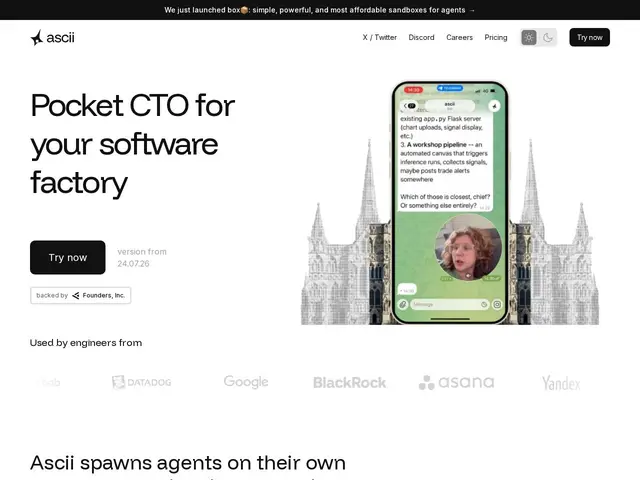
Description
Most AI coding tools still expect you to sit in the driver's seat, prompting one task at a time. Ascii flips that: you hand it a backlog of tasks, and it spins up several coding agents in parallel, each working inside its own sandboxed copy of your repo, so you come back to a stack of finished pull requests instead of a single chat session.
Ascii is a platform for orchestrating autonomous coding agents across multiple repositories. Each agent runs in an isolated "box" (sandbox), pulls a task, writes code, executes tests, and iterates until the change is ready for human review — without needing a developer to babysit every step. It's aimed at engineering teams that want to offload well-scoped, repetitive work (bug fixes, small features, dependency bumps, test coverage) so human engineers can focus on architecture and judgment calls. Pricing is agent-count based: a 7-day free trial on the Base tier, then Base at $19/month (50 agents), Max at $75/month (1000 agents), and Ultra at $199/month (10000 agents) — the platform states it is used at companies including Airbnb, Google, Datadog, and BlackRock.
💬 Our review
The short version: if your team has a pile of small, well-defined engineering tickets and wants to try running several AI agents on them in parallel instead of one Cursor/Claude Code session at a time, Ascii is built exactly for that — but it lives or dies on how well it handles tasks that turn out to be less well-defined than they looked.
The category here — autonomous multi-agent coding orchestration — is getting crowded fast: Devin (Cognition) pioneered the "AI engineer you assign tickets to" pitch, Charlie Labs' Daemons keeps agents working across repos and alerts, and Codegen and OpenHands offer open or semi-open alternatives to the same idea. Ascii's angle is sandboxed parallelism at a defined agent-count price rather than a per-task or per-seat model, which is easy to reason about for a team scaling up usage, but also means cost rises with breadth of work attempted rather than with results delivered. The named enterprise logos (Airbnb, Google, Datadog, BlackRock) are a credibility signal, though as with any agentic coding tool in 2026 the real question isn't whether it can write code — it's how much review overhead the output creates. Worth trialling on a genuinely low-risk backlog (chores, small bugs) before trusting it with anything customer-facing; the $19/month entry tier makes that trial cheap.
📊 Global score
🤖 AI-enriched data
Essai gratuit 7 jours (palier Base) ; Base 19$/mois (50 agents) ; Max 75$/mois (1000 agents) ; Ultra 199$/mois (10000 agents)
Pros
Parallélisation réelle — plusieurs agents travaillent simultanément dans des sandboxes isolées
Tarification claire par nombre d'agents plutôt que par usage imprévisible
Cite des clients entreprise reconnus (Airbnb, Google, Datadog, BlackRock)
Essai gratuit à faible risque avant engagement payant
Cons
Marché très concurrentiel (Devin, Charlie Labs, Codegen, OpenHands) qui évolue vite
Le coût grimpe avec le nombre d'agents lancés, pas avec la valeur livrée
Nécessite une revue humaine sérieuse — pas fait pour du code critique sans supervision
Date de fondation et taille de l'équipe non communiquées