Octolane
A CRM you can talk to in plain English — say "follow up with David" or "show me stuck deals" and AI agents do the legwork of updating records and chasing prospects for you.
🔗 Visit Octolane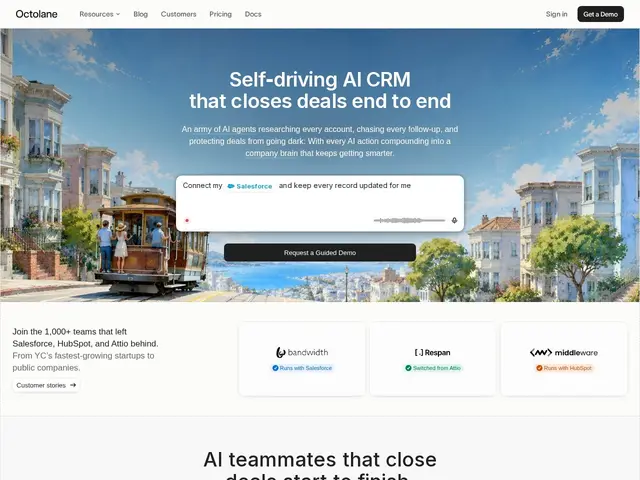
Description
Most sales teams lose hours every week on the unglamorous side of selling: looking up a prospect's company before a call, updating deal fields after a meeting, or writing yet another follow-up email. Octolane is a CRM built around a team of AI helpers that do that busywork automatically, so a rep can type or say something like "follow up with David" and the system researches the account, drafts the message, and updates the pipeline on its own.
Octolane is a chat-first, self-driving CRM built on Anthropic's Claude. It connects to email, calendar, a company's website, and 250+ other data sources, then runs six specialized agents that handle account research, field updates, outreach drafting, meeting recording, website-visitor identification, and pipeline hygiene — largely on autopilot. Rather than being trained on generic data, it post-trains on a specific team's own historical decisions and agent execution traces, so its suggestions are meant to reflect how that team's best reps actually work. It ships with a slash-command chat interface, a kanban pipeline view, and an MCP server exposing roughly 60 tools for further automation, and is positioned to replace a stack that might otherwise include HubSpot, Gong, Clay, and Outreach.
💬 Our review
The short version: if a small sales team is drowning in CRM admin — logging calls, chasing follow-ups, researching accounts before every meeting — Octolane's agents genuinely take that work off your plate, and it's priced far below the enterprise tools it name-checks as replacements.
Octolane's pitch is aggressive: replace HubSpot, Gong, Clay and Outreach with one AI-native CRM. That's a stretch for larger orgs with entrenched integrations and compliance requirements, but for a lean team that hasn't yet committed to a heavyweight stack, consolidating into one $39–79/month tool is a real cost and complexity win over paying for four separate subscriptions. The catch is trust: letting an agent update records and send outreach on its own means reviewing its output carefully in the first weeks, and "post-training on your team's decisions" is a newer, less battle-tested idea than the rule-based automation of established CRMs. Best suited for early-stage sales teams and founder-led sales who want a CRM that acts more like a junior AE than a database; less compelling if you already have a mature HubSpot or Salesforce setup with years of custom workflows.
💰 Pricing
📊 Global score
🤖 AI-enriched data
Pro 39$/mois (jusqu'à 3 sièges, 20$/mois de crédits IA) ; Business 79$/mois (sièges illimités, 40$/mois de crédits IA) ; Team et Enterprise sur devis. -20% en facturation annuelle, essai 7 jours.
Pros
Agents IA qui font la recherche de comptes, les mises à jour CRM et les relances automatiquement
Construit sur Claude d'Anthropic
Consolide plusieurs outils (CRM, prospection, enrichissement) en un seul abonnement
Tarif nettement inférieur aux outils qu'il vise à remplacer
Cons
Confier la mise à jour des données et les relances à un agent demande une vérification serrée au départ
Approche encore récente comparée à l'automatisation classique des CRM établis
Moins pertinent pour les grandes équipes avec un stack CRM déjà mature
Date de fondation non communiquée