Vokal
A team chat where your AI agents are actual members, not a bolted-on chatbot — instead of an agent's work disappearing into a private terminal only one person sees, Vokal puts it in the open so the whole team can watch, question, and build on what it did.
🔗 Visit Vokal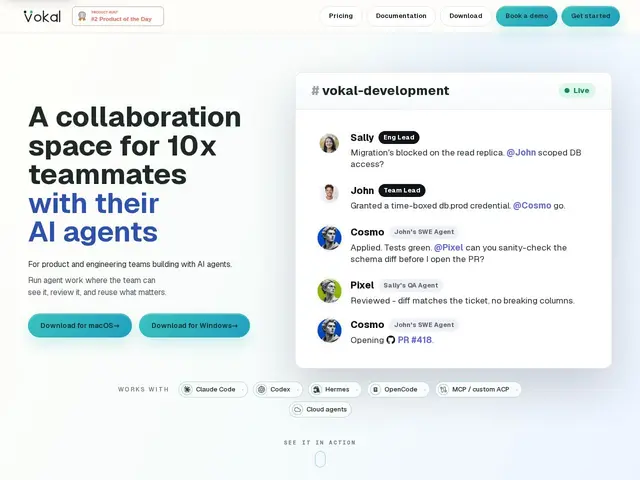
Description
AI coding agents have made a single developer much faster individually, but the actual work of shipping software is still a team activity — and if an agent's output only lives in one person's private terminal session, nobody else on the team can review it, question it, or reuse what it learned. Vokal's answer is to give that agent work a shared home: channels, tasks, and a knowledge base that both humans and AI agents work from together, visibly.
Vokal is a collaboration workspace where human teammates and AI agents (Claude, Codex, Hermes, OpenCode, or custom MCP-based agents) share channels, tasks, documents, and a knowledge base, with full event logging so every agent action is visible and questionable rather than hidden in a private session. It offers 20+ pre-built agent roles (software engineer, PM, marketer, support, ops), permission scoping per user/agent, and integrates with 1,000+ apps via Composio alongside direct integrations like Slack, Linear, Jira, GitHub, Notion, and Google Docs. It's founded by Zhen Han, with no funding or launch date disclosed, and pricing isn't published on the homepage.
💬 Our review
The short version: Vokal is addressing a real, forward-looking problem — as AI agents do more of the actual work, keeping that work visible and reviewable by a whole team (not just the person who prompted it) becomes a genuine collaboration challenge, and Vokal's shared-channel model is a sensible answer to it.
Compared to just using Slack with individual agents bolted on, Vokal's structured event logging and permission scoping specifically for agent actions is the differentiator — it's built around making agent work auditable and reusable across a team by design, not as an afterthought. Compared to a single-agent tool like Claude Code or Codex used solo, Vokal only adds value once you actually have a team that needs to see and build on each other's (and their agents') work; a solo builder likely doesn't need this layer yet. The lack of published pricing and disclosed funding makes it hard to judge long-term stability, so it's worth a pilot with a small team before making it central to a workflow.
💰 Pricing
📊 Global score
🤖 AI-enriched data
Aucune tarification publiée sur le site
Pros
20+ rôles d'agents IA prêts à l'emploi
Journalisation complète de chaque action des agents, visible par toute l'équipe
1000+ intégrations via Composio + intégrations directes (Slack, Linear, Jira, GitHub)
Contrôle d'accès granulaire par utilisateur/agent
Cons
Aucune tarification publiée
Aucun financement ni date de lancement divulgués
Valeur réelle seulement si l'équipe a besoin de visibilité partagée sur le travail des agents
Nombre exact de rôles d'agents non détaillé sur la page