Superlog
A self-installing mechanic for your app's bugs — instead of you wiring up monitoring tools and then manually digging through logs when something breaks, Superlog instruments your code itself, groups the mess into one clear incident, and shows up with a re
🔗 Visit Superlog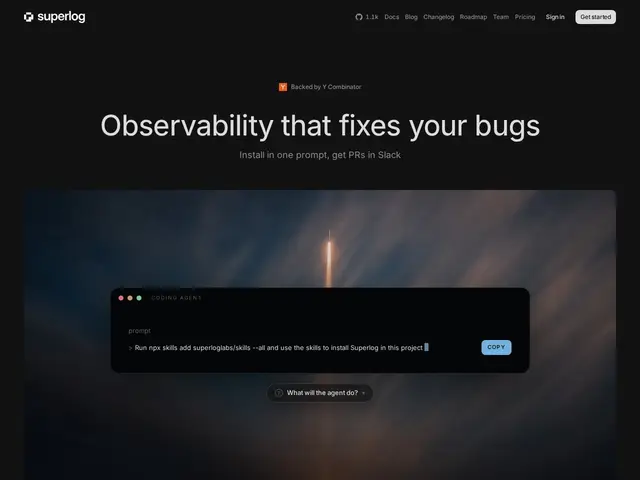
Description
Setting up proper observability (the tools that tell you what actually broke and why) is normally its own project: choosing a vendor, instrumenting the code, and then still manually sifting through logs and traces once an alert fires. Superlog collapses that whole chain — it adds the instrumentation itself with a single prompt, and when something breaks, it groups the noise into one incident and proposes an actual pull request to fix it, rather than just paging someone.
Superlog is an open-source (Apache 2.0), Y Combinator-backed observability platform that self-instruments a codebase with OpenTelemetry, then uses AI to fingerprint and group errors, score incident severity (SEV1-3), and generate mergeable pull-request fixes, all exposed through GitHub and Slack with Model Context Protocol (MCP) access to logs, traces, metrics, and alerts. It's built by Pulsent Labs Inc., has around 1,100 GitHub stars, and says it's used by 13+ companies including Plato, LightSprint, and Datost. The free community edition is fully open source and self-hostable; paid tiers exist but pricing details weren't published on the pages checked.
💬 Our review
The short version: for a small engineering team that doesn't want to become full-time observability administrators, Superlog's self-instrumenting, self-diagnosing, self-fixing pitch is aimed at removing an entire category of grunt work — and being open source and Apache-licensed means you're not locked into a vendor relationship to get there.
Compared to Datadog or Sentry, the established players in this space, Superlog's real differentiator is the "no setup, no alert fatigue, no manual fixing" framing — it's trying to replace not just the dashboard but the manual triage and the fix-writing step too. That's a bigger promise than a traditional observability vendor makes, so the honest caveat is that automatically-generated PR fixes for production bugs deserve real code review before merging, no matter how good the AI grouping and severity scoring is — treat the PR as a strong first draft, not a rubber-stamp merge.
💰 Pricing
📊 Global score
🤖 AI-enriched data
Édition communautaire gratuite et open source (Apache 2.0, auto-hébergeable) ; paliers payants existants mais détails non publiés
Pros
Auto-instrumentation du code en un prompt, sans setup manuel
Regroupement intelligent des incidents et scoring de sévérité
Propose directement une pull request de correctif
Open source (Apache 2.0), soutenu par Y Combinator
Cons
Détails de tarification des paliers payants non publiés
Les PR générées automatiquement nécessitent quand même une vraie revue de code
Date de fondation exacte non publiée